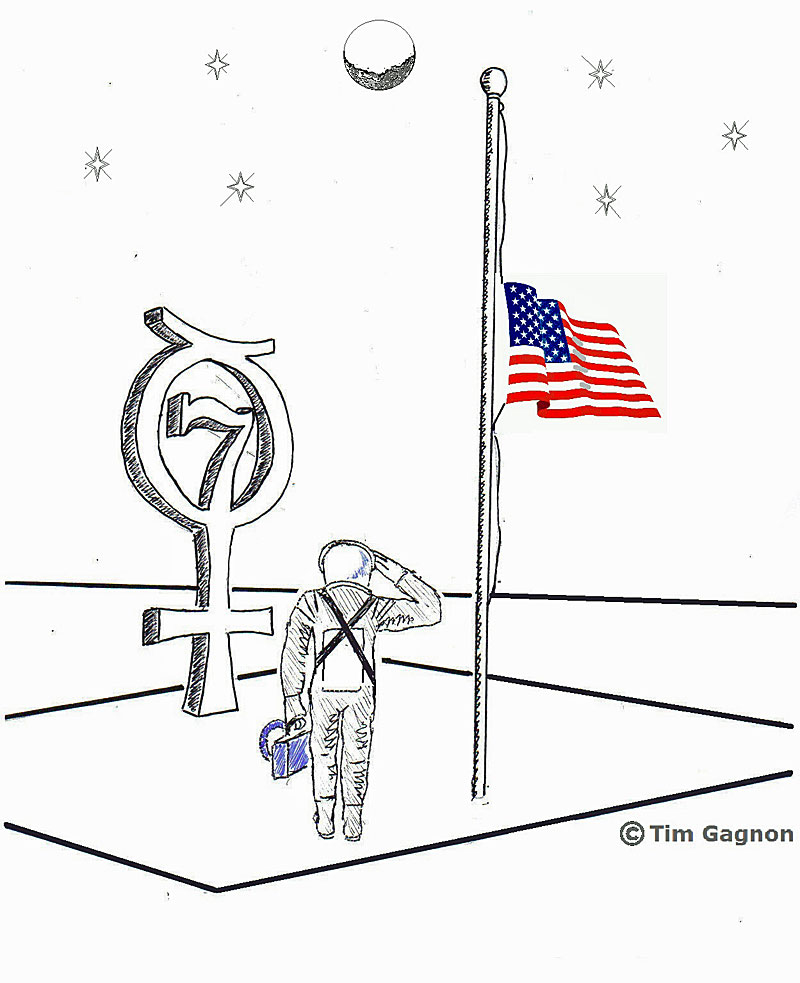
The date of the
NASA ceremonial tree planting in Scott's memory will be
announced
as soon as the date is confirmed. The rumored February
18th date is NOT true.
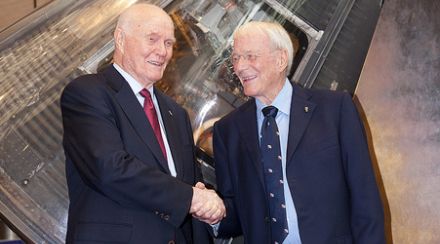
Original Astronauts at National Air and Space Museum: John Glenn and Scott Carpenter are the only surviving members of the country's original astronaut corps.
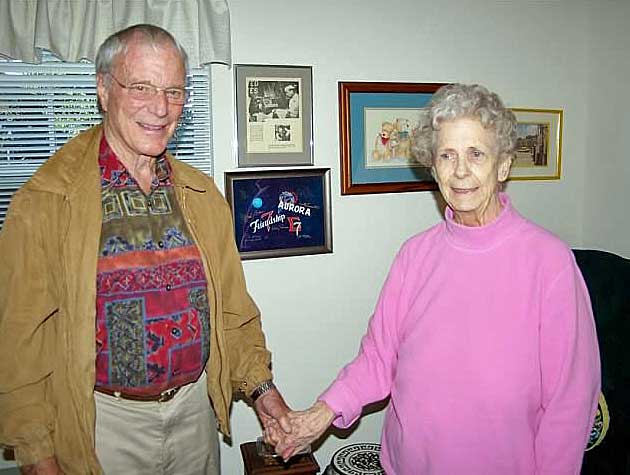
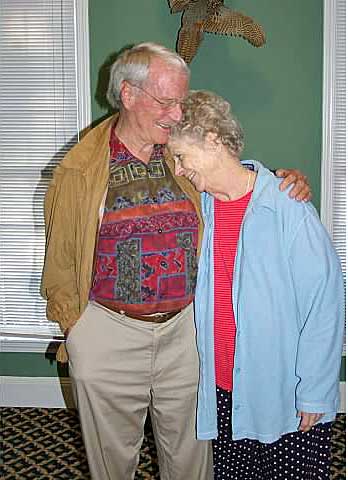
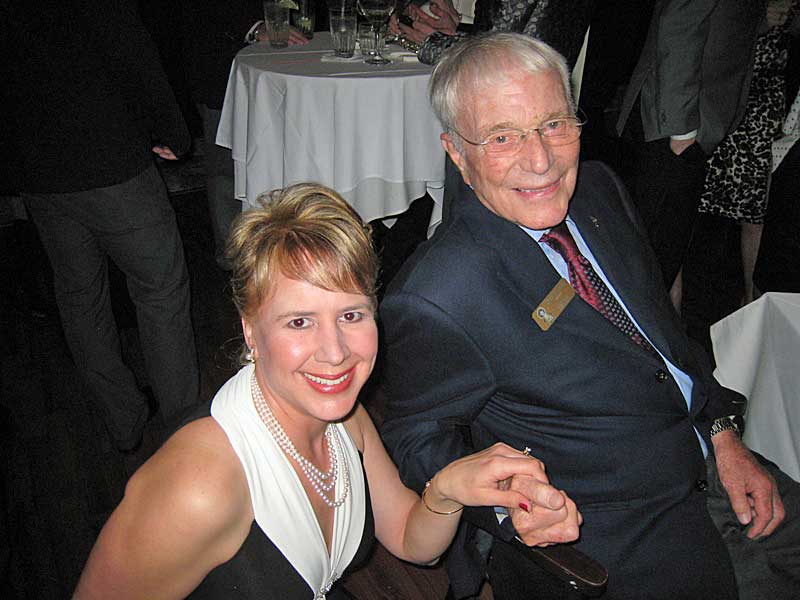
Pictures from various appearances.
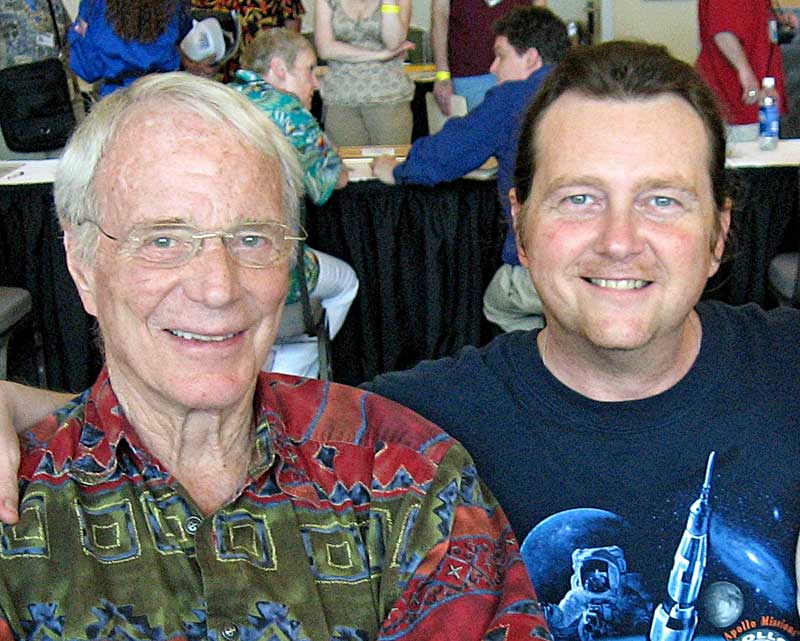
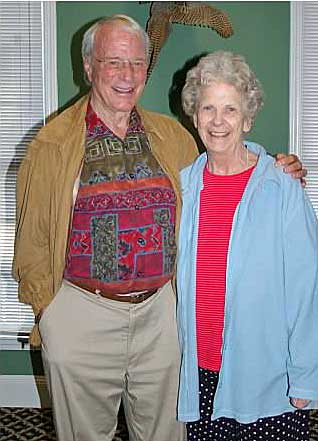
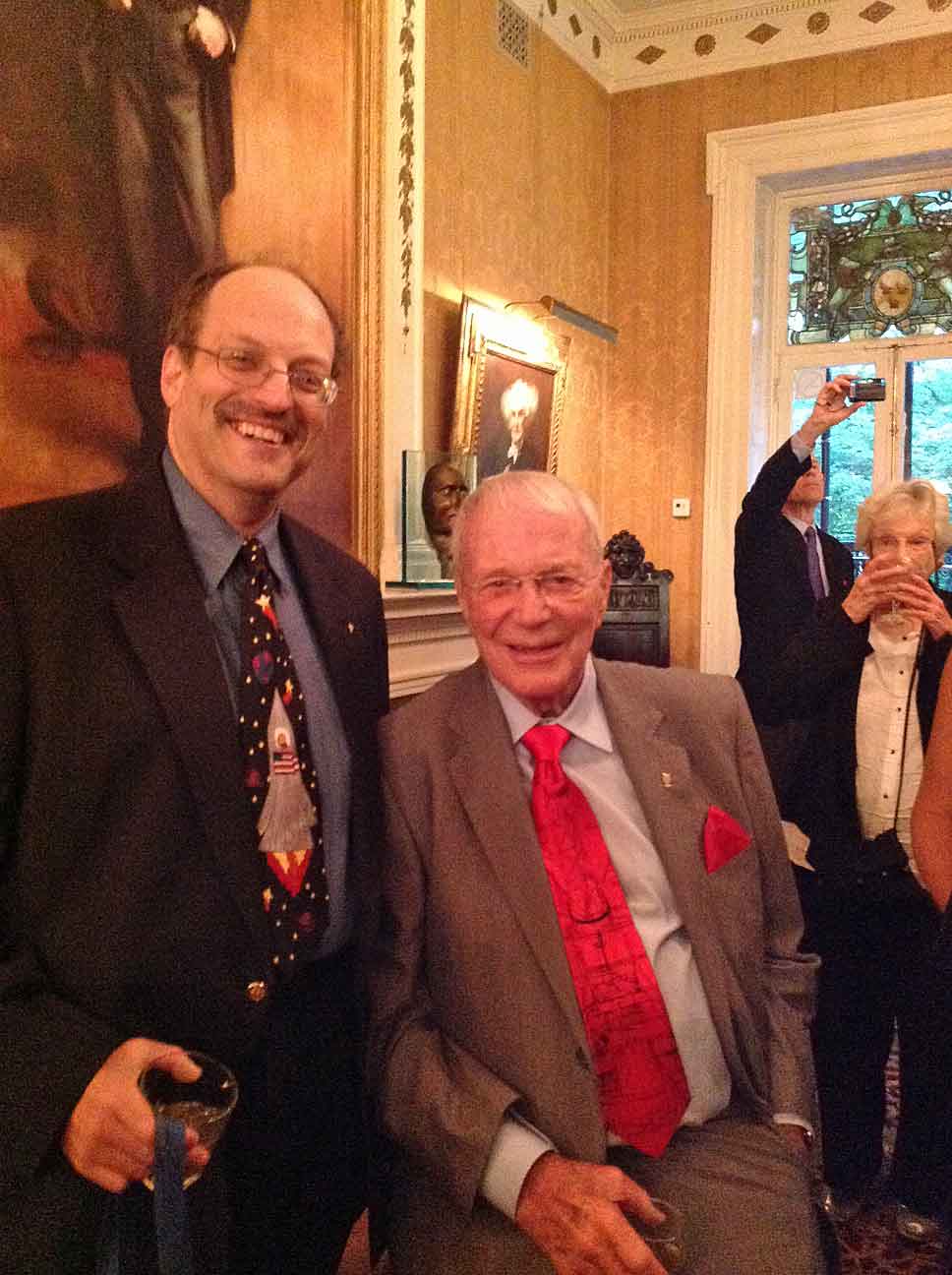
Scott and
Astronaut Nurse Dee O'Hara in 2007
I've
had the pleasure of working with Scott Carpenter for
several years, both as his webmaster and his friend.
I've been lucky enough to befriend many of the
"golden age" astronauts as well as their support
staff. Along with Scott, I had the pleasure of
getting to know Gordon Cooper and Wally Schirra.
Scott, Wally and Gordo were magnificent men who flew
into the unknown simply to go higher, faster and
farther than anyone else. The greatest group of
gentleman that it was my pleasure to meet and get to
know.
Scott was a
gentle man. I often referred to him as "a poet".
When I met him many years ago, there was no "pilot
ego" or any sense of a "hot, fighter jock". He was
always there to extend his hand and thank you for
making his acquaintance. Personally, I will miss the
many messages that he left on my answering machine
that always started with "How is my old friend,
Tracy Kornfeld?". Our conversations were wonderful.
When my wife passed away, he called with encouraging
words that I still repeat to myself today. How odd
that he passed on the same day as my wife, seven
years later. You will both be dearly missed,
Godspeed, Scott Carpenter
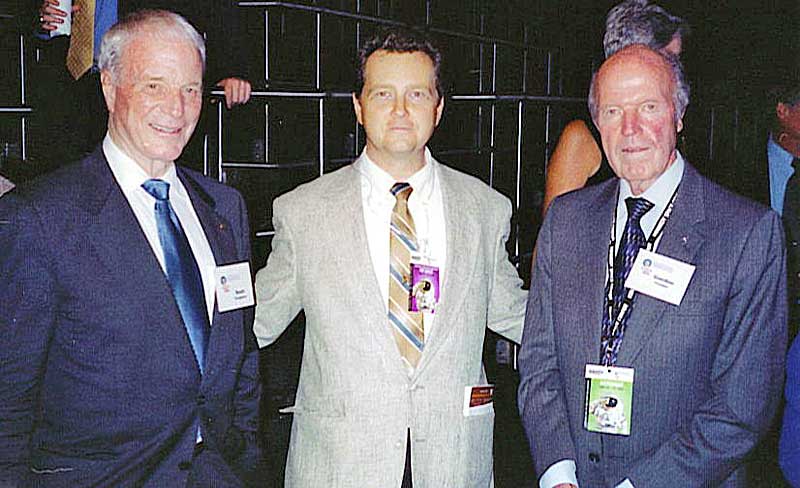
and thank you for your wonderful friendship. I will
never forget our times together and the wonderful
invitation to the celebration of the 50th
anniversary of your Aurora 7 flight as pictured
above. A generous man who I will never forget.
Posted: 10/10/2013 02:05:07 PM MDT | Updated: 4
months ago
Legendary Boulder-born astronaut Scott Carpenter --
who in 1962 became the second American to orbit the
Earth and the first person to explore both the
heights of space and depths of the ocean -- died
Thursday in Denver with his wife at his side. He was
88.
Along with John Glenn, who flew three months before
him, Carpenter was one of the last two survivors of
the original Mercury 7 astronauts for the fledgling
U.S. space program. He lived in Vail until a few
weeks ago, when he suffered a stroke that put him in
Swedish Medical Center and, eventually, The Denver
Hospice at Lowry.
"On Sunday, we watched the Broncos-Dallas game and
he was very verbal," his daughter Candy Carpenter
said Thursday.
But he took a turn for the worse the next day and
never recovered.
Candy Carpenter, 57, said her father died peacefully
at 5:30 a.m. of complications from the stroke with
his wife, Patty Barrett, by his side.
"He wanted to be the best pilot, he wanted to be the
best navigator, he wanted to be the best father, he
wanted to be the best diver," Candy Carpenter said.
"He wanted to be the best at everything."
She said he also came from an era when astronauts
regularly put their lives on the line testing out
new equipment and new technologies in situations and
conditions humans had never before faced.
"That was one of the things he was most proud of was
to be able to go to space and prove or disprove all
those fears," she said. "He loved machines."
Gordon Page, founder of the Spirit of Flight Center
in Erie, credits Carpenter with setting the stage
for the hundreds of astronauts who would come after
him. He was part of a select group of early space
explorers who likely didn't fully recognize just how
much their bravery and determination would push
forward an industry that now plays an instrumental
role in both Boulder County and Colorado as a whole,
Page said.
Scott Carpenter laughs while a guest speaker makes a
joke on Thursday, Sept. 20, 2012, during the Scott
Carpenter Park re-dedication ceremony in Boulder.
(Jeremy Papasso / Daily Camera)
"I see him as the starting point -- look at all the
jobs and technological advances that just these few
guys played a role in producing," Page said. "It was
a unique point in American history that allowed
people to break records and go further than ever
before without a lot of red tape and budget issues."
'Willingly give my life'
Carpenter, who was born in Boulder on May 1, 1925,
as Malcolm Scott Carpenter (he hated his first name
and didn't use it), began to look skyward for
inspiration at a very young age.
"The big influence for my father as a 5-year-old was
seeing Lowry Air Force Base being built and
Stapleton Airport being built," daughter Kris
Stoever said Thursday. "It was the first time he saw
an airplane overhead."
In this Aug.1962 photo, astronaut Scott Carpenter
has his space suit adjusted by a technician in Cape
Canaveral, Fla. Carpenter, the second American to
orbit the Earth and one of the last surviving
original Mercury 7 astronauts, died Thursday, Oct.
10, 2013. He was 88. (AP Photo, File) (Uncredited)
His maternal grandparents raised Carpenter after his
mother became ill with tuberculosis and his parents
split up. Stoever said her father loved climbing the
Flatirons and pastured a horse, named Lady Luck, at
the base of Flagstaff Mountain.
"Boulder formed my father," she said.
And he was recognized by the city. A park at 30th
Street and Arapahoe Avenue was after the astronaut,
while Boulder's Aurora 7 Elementary took its name
from Carpenter's Mercury capsule. Scott Carpenter
Park was rededicated last year to celebrate the 50th
anniversary of his space flight.
Carpenter graduated from Boulder High in 1943 and
went on to the University of Colorado, but only
attended one semester before joining the Navy's
V-12a training program, designed to help train
pilots during World War II.
He returned to CU to study aeronautical engineering,
but, in 1949, rejoined the Navy and continued his
pilot training -- one course short of finishing his
bachelor's degree.
On April 9, 1959, after a decade in the Navy, the
newly formed National Aeronautics and Space
Administration announced that Carpenter was one of
seven chosen to be part of its first astronaut
group, which came to be known as the Mercury 7.
The launch into space on the morning of May 24,
1962, was nerve-racking for the Navy pilot.
"You're looking out at a totally black sky, seeing
an altimeter reading of 90,000 feet and realize you
are going straight up. And the thought crossed my
mind: 'What am I doing?'" Carpenter said 49 years
later in a joint lecture with Glenn at the
Smithsonian Institution.
Scott Carpenter rides with his wife, Rene, and his
sons, Scotty and Jay, in Hawaii in the early 1950s.
(Photo courtesy of Carnegie Branch Library for Local
History)
For Carpenter, the momentary fear was worth it, he
said in 2011: "The view of Mother Earth and the
weightlessness is an addictive combination of
senses."
For the veteran Navy officer, flying in space or
diving to the ocean floor was more than a calling.
In 1959, soon after being chosen one of NASA's
pioneering seven astronauts, Carpenter wrote about
his hopes, concluding: "This is something I would
willingly give my life for."
Three months later, Carpenter was launched into
space from Cape Canaveral, Fla., and completed three
orbits around Earth in his space capsule, the Aurora
7, which he named after the celestial event. It was
just a coincidence, Carpenter said, that he grew up
on the corner of Aurora Avenue and Seventh Street in
Boulder.
His four hours, 39 minutes and 32 seconds of
weightlessness were "the nicest thing that ever
happened to me," Carpenter told a NASA historian.
"The zero-g sensation and the visual sensation of
spaceflight are transcending experiences and I wish
everybody could have them."
His trip led to many discoveries about spacecraft
navigation and space itself, such as that space
offers almost no resistance, which he found out by
trailing a balloon. Carpenter said astronauts in the
Mercury program found most of their motivation from
the space race with the Russians. When he completed
his orbit of the Earth, he said he thought: "Hooray,
we're tied with the Soviets," who had completed two
manned orbits at that time.
'We may have... lost an astronaut'
But things started to go wrong on re-entry. He was
low on fuel and a key instrument that tells the
pilot which way the capsule is pointing
malfunctioned, forcing Carpenter to manually take
over control of the landing. NASA's Mission Control
then announced that he would overshoot his landing
zone by more than 200 miles and, worse, they had
lost contact with him.
Talking to a suddenly solemn nation, CBS newsman
Walter Cronkite told the audience: "We may have ...
lost an astronaut."
At a time when astronauts achieved fame on par with
rock stars, folks across the country sat glued to
their TV screens, anxiously awaiting the outcome of
Carpenter's mission. Dave Klaus, a professor in
aerospace engineering sciences at CU, said the
routine nature of space travel today and the
assurances people take from that simply didn't exist
then.
"There was a lot of unknowns and a lot of
uncertainty at that time," Klaus said.
But Carpenter survived the landing that day.
Always cool under pressure -- his heart rate never
went above 105 during the flight -- he oriented
himself by simply peering out the space capsule's
window. The Navy found him in the Caribbean,
floating in his life raft with his feet propped up.
He offered up some of his space rations.
Carpenter's perceived nonchalance didn't sit well
some with NASA officials, particularly flight
director Chris Kraft. The two feuded about it from
then on.
Kraft accused Carpenter of being distracted and
behind schedule, as well as making poor decisions.
He blamed Carpenter for the low fuel.
On his website, Carpenter acknowledged that he
didn't shut off a switch at the right time, doubling
fuel loss. Still, in his 2003 memoir, he wrote: "I
think the data shows that the machine failed."
From deep space to deep seas
Carpenter never did go back in space, but his
explorations continued. In 1965, he spent 30 days
under the ocean off the coast of California as part
of the Navy's SeaLab II program. Once again the
motivation was both fear and curiosity.
"I wanted, No. 1, to learn about it (the ocean), but
No. 2, I wanted to get rid of what was an unreasoned
fear of the deep water," Carpenter told the NASA
historian.
Inspired by Jacques Cousteau, Carpenter worked with
the Navy to bring some of NASA's training and
technology to the sea floor. A broken arm kept him
out of the first SeaLab, but he made the second in
1965. The 57-by-12-foot habitat was lowered to a
depth of 205 feet off San Diego. A bottlenose
dolphin named Tuffy ferried supplies from the
surface to the aquanauts below.
"SeaLab was an apartment, but it was very crowded.
Ten men lived inside. We worked very hard. We slept
very little," he recalled in a 1969 interview. Years
later, he said he actually preferred his experience
on the ocean floor to his time in space.
"In the overall scheme of things, it's the underdog
in terms of funding and public interest," he said.
"They're both very important explorations. One is
much more glorious than the other. Both have
tremendous potential."
After another stint at NASA in the mid-1960s,
helping develop the Apollo lunar lander, Carpenter
returned to the SeaLab program as director of
aquanaut operations for SeaLab III.
He retired from the Navy in 1969, founded his
company Sea Sciences Inc., worked closely with
Cousteau and dove in most of the world's oceans,
including under the ice in the Arctic.
When the 77-year-old Glenn returned to orbit in 1998
aboard space shuttle Discovery, Carpenter radioed:
"Good luck, have a safe flight and ... once again,
Godspeed, John Glenn."
His influence felt at CU
At CU, Carpenter will be primarily remembered for
his legacy in space.
Klaus said there have been 20 astronauts affiliated
in some way with CU, including Kalpana Chawla, who
was killed in the Columbia accident in 2003, and
Ellison Onizuka, who died in the Challenger accident
in 1986.
"He was the first of a long string of astronauts
that came out of CU," he said. "He was a living
legend."
Klaus remembers Carpenter making a visit to CU about
10 years ago, where a number of aerospace
engineering students put on a presentation for him.
Carpenter told Klaus that he was fascinated with the
latest advancements in space travel technology and
materials and would welcome the chance to start all
over again learning about the field.
"He was excited to see the next generation coming
up," Klaus said.
CU-Boulder Chancellor Phil DiStefano said Thursday
that Carpenter will be "sorely missed."
"In his two-decades-long career as a Naval aviator,
astronaut and aquanaut, Scott Carpenter brought
honor and distinction to CU-Boulder while embodying
the adventurous spirit of our nation," DiStefano
said. "Our space program, and all space and ocean
researchers everywhere, owe him a debt of
gratitude."
Although Carpenter was one course requirement short
of graduating with a bachelor's degree in
aeronautical engineering when he left CU in 1949,
the university awarded him his degree in 1962
following the successful Aurora 7 flight.
When presenting the degree to Carpenter, then-CU
President Quigg Newton noted that "his subsequent
training as an astronaut has more than made up for
his deficiency in the subject of heat transfer."
Stoever, who co-wrote with her father the book "For
Spacious Skies: The Uncommon Journey of a Mercury
Astronaut," said there's no doubt her father's time
at CU helped boost the school's aeronautical
engineering reputation.
"Being a Project Mercury astronaut gave CU a lot of
cachet," she said.
Great father, great teacher
But at the heart of it all, Stoever said, Carpenter
was a man, a father and a great teacher.
"He was unusual in his generation for being gentle,
kind and patient," she said. "He loved explaining
how to do things the right way."
Candy Carpenter said her father, who married four
times and had eight children, shone in areas much
more grounded than space travel. He wrote two
novels: "The Steel Albatross" and "Deep Flight." And
he absolutely loved music.
Candy Carpenter said she'll always remember her
father singing and playing guitar. When she had to
be flown by rescue helicopter from her home in Big
Elk Meadows in Larimer County during last month's
floods, Carpenter said besides grabbing her dog, she
made sure to bring with her the Gretsch guitar her
father bought with Glenn in New York City in 1957.
His children all picked up the instrument, Candy
Carpenter said, and she went on to become a guitar
teacher in Longmont.
"And that was because he played guitar," she said.
"He was a fabulous teacher, had a great sense of
humor and was handsome as the Devil."
I'll
never forget a day I spent with Scott Carpenter at
his home in Vail a few years ago. He and Patty were
gracious hosts, and it was one of the best days I've
had in journalism. Scott was a genuinely nice man,
and a great interview for a magazine feature I was
writing. We talked for a while about his 1962
spaceflight, but more than anything, we talked about
the future. He was
convinced that someday kids will again grow up with
the kind of excitement
about space travel that many of us had in the 1960s
and '70s. A human trip to
Mars might do the trick.
Scott was particularly good at relating to kids, and
he often addressed them during his talks. He told me
that at one of these events, he asked a young boy if
he might want to be the first person to set foot on
Mars, and the kid
answered: "Yeah, but could I take my mom?"
Rest in peace, Scott.
~Mark M.
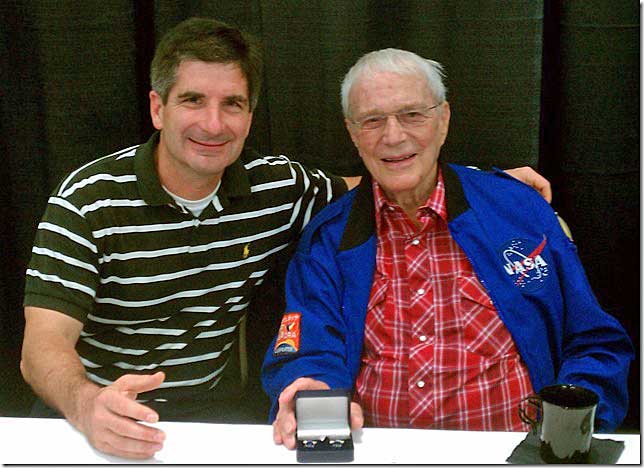
I’m at a table with a couple of astronauts and
Scott Carpenter at the ASF reception last year.
I decide to break the ice with a quick story
about my dad and an exploding cigar. One looks
amused, another laughs, but Carpenter cracks up!
Right then I know I’ve found a friend and I get
an idea; I’ve got a cheap pair of Nasa cufflinks
I picked up that day and I hand ‘em to Cmdr.
Carpenter and say “Here I’m giving my cufflinks
to you.” He says “What for?” and I reply “So you
can give ‘em back to me and I can tell all my
pilot buddies Scott Carpenter gave me these!” He
thinks it’s a grand idea, but says they won’t
believe it without a picture and unfortunately
my phone is dead. So, Scott says “bring ‘em by
tomorrow and we’ll stage the whole thing!” Well
now there’s the picture proof and that’s how I
got my fine Nasa cufflinks from my very close
personal friend (for one brief evening) Mercury
Astronaut Scott Carpenter. He was the best!
~Major Ron F.
Scott was one of the finest, most considerate gentleman you would ever
meet, and a good friend. His life was filled with ups and downs, but he
never let it affect his attitude. We will miss him.
~Walter Cunningham, LMP, Apollo 7
So long Scottie. Thank you for being one of the men who inspired me to
become a pilot. Godspeed old friend.
It was with
huge sadness I heard the news this morning
in the UK.
Scott was a
true gentleman to all of us who met him back
in 90's while we were working on the
Sovereign of the Seas in the photo
department. My friends some of whom now live
in Australia, Europe and the the US have
posted on facebook their memories and the
group photograph he so kindly posed for.
For
his flight into space and pioneering work in
Sealab he will forever remain an inspiration
to us all.
~David & Dawn
Had the
pleasure in meeting Scott 3 times here in
the UK, I’m so glad I took both my daughters
to see him, also he was great with them..RIP
Scott..
~Ian A.
I
first met Scott Carpenter in 1992
at a fund raising event for the
Astronaut Scholarship Foundation:
"Celebrating 30 Years of Americans in
Space."
Over the years I had the pleasure to
meet him a number of times.
His book signing in Cocoa Beach
in 2003 and the ASF Autograph Show more
than once. At one show I gifted
Mr. Carpenter one of my Mercury
Commemorative patches and that opened
the door to discuss the possibility of
designing a special 50th Anniversary
commemorative to mark his space flight
aboard Aurora 7.
At
the unveiling of the Alan Shepard US
Postal Stamp at the
Kennedy Space Center Visitor Complex
, I presented him with the prototype
patch that
Jorge Cartes
and
I designed. Soon after I received a
phone call from him with the request to
produce it. Scott Carpenter was always
kind and gracious to me. He appreciated
my effort on his behalf.
I will
forever be grateful to have had the
chance to work with a childhood hero.
Godspeed Scott Carpenter.
~Tim G.
I just
wanted to express my sadness in knowing
that one of the United States great
heroes, pioneer and visionaries is now
in God’s hands. Myself at the age of
59…I will be there in 20… or 30
years….cannot wait to talk to him. Your
whole family has so much to be proud
of….he is burned into my memory.
~Scott F.
I would
like to express my sincere condolences
for the loss of Cmdr. Carpenter on
Thursday 10th of October. I wish his
family and friends all the strength to
cope with this great loss.
What was most impressive about him when
I read his interviews was his eye for
detail and his detailed story and
anecdote telling. I loved the anecdotes
about the sharks and his way of fighting
his fear for the big oceans. Also the
detailed descriptions of the test for
becoming an astronaut which were pretty
tough these days and which he describes
in an unforgettable detailed and also
lighthearted way. He even called these
tests 'a lot of fun'.
Like I wrote, I collect story's,
anecdotes and articles and library's and
newspapers have send me quite a lot. In
Cmdr. Carpenters words, he told in his
interview in the oral history project,
he could tell another hundred thousand
of story's, I will go on until this
number of hundred thousand.
From the Netherlands.
~Angele
Thanks for setting a
great example and shooting for the
stars.
An American Hero
~David & Maureen E.
We had some great times together
over the years.
May God be with you Scott.
~Bob S.
Good evening from France
I wish to send my thoughts and blesses
to Mr. Carpenter.
Still a piece of my heroes who leaves
our good Earth.
May god bless him and rest in peace
among the stars.
~Daniel G.
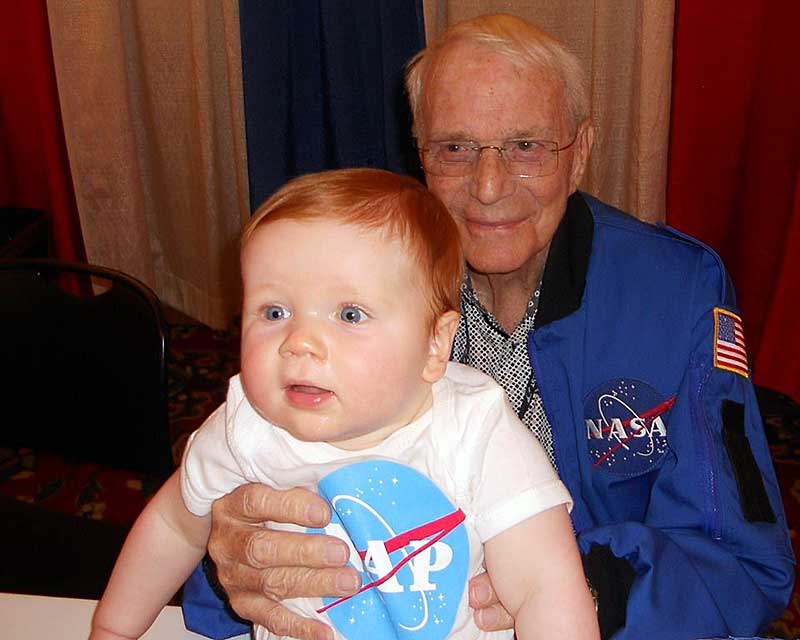
Mr. Carpenter was so kind to my
little boy when he posed for this
photo in May, and it's a memory that
won't soon be forgotten.
One day in the future my son might
be one of the oldest people (god
willing) around to be able to
say that they met the legendary
Scott Carpenter.
~Jason R.
Scott Carpenter Family;
Please accept our sincere
condolences in the lost of your
father/husband Scott. I'll always
remember him as a sincere, always
inquisitive officer while serving
with him aboard the USS Hornet in
1958-59.
Regards,
~Don & Billie H.
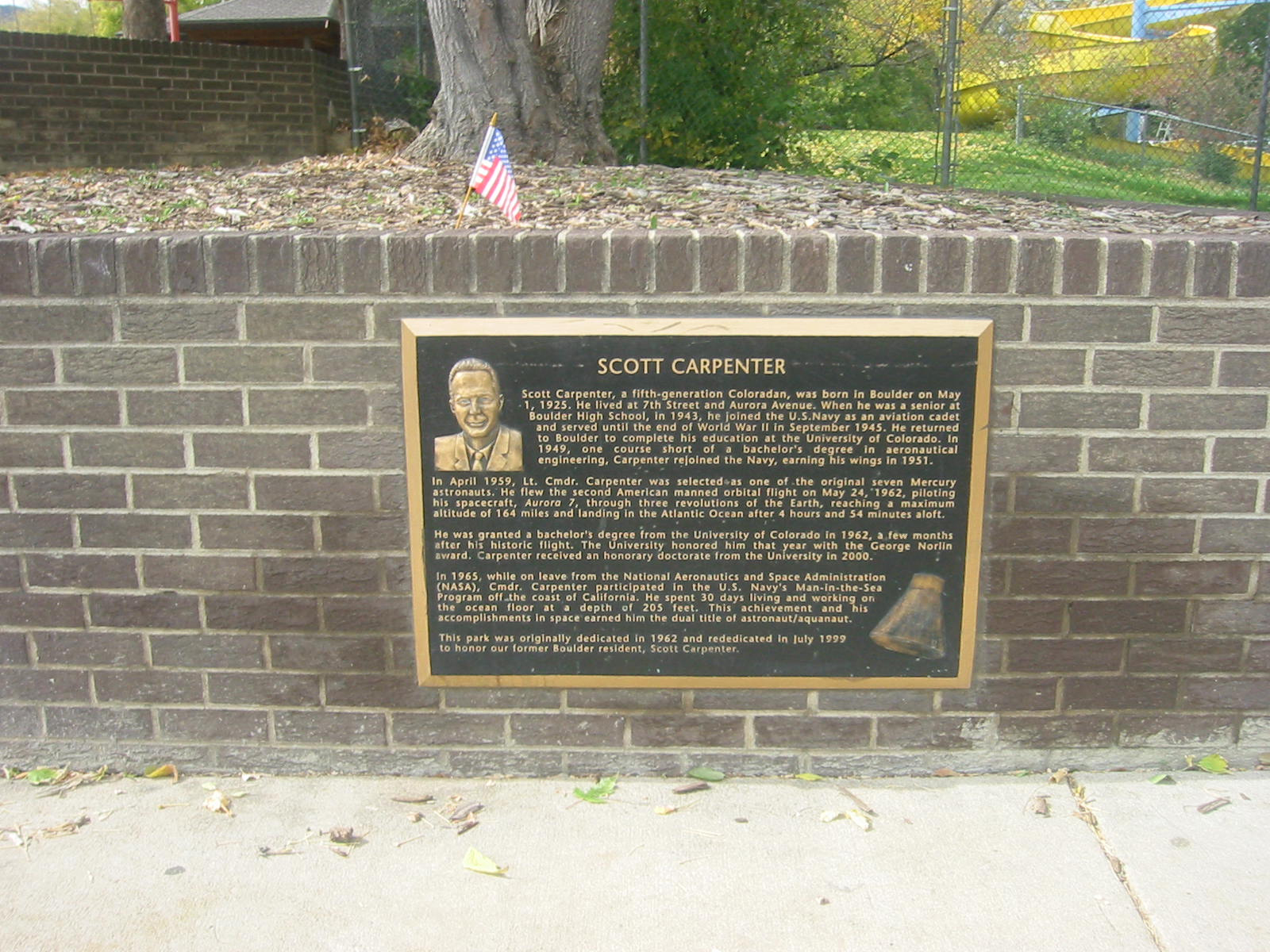
I drove by the
plaque at Scott Carpenter Park in
Boulder last Friday and thought you
might like to see the photo I took
of the small tribute some kind soul
left.
~David S.
I will
greatly miss Scott Carpenter. He was
a personal hero and role model, but
more than that, he extended his
friendship, for which I will always
be grateful.
There are numerous stories I could
share, but the one that comes
foremost to
mind
is from September 2007. I had helped
organize a space memorabilia show at
NASA's Glenn Research Center in Ohio
and Scott was the guest of honor.
The day after the show ended, he and
I both had flights out of Cleveland
scheduled for late in the afternoon,
but we didn't have any plans to see
each other that day.
I was preparing to check out of the
hotel when the phone rang.
"Hi, it's Scott, take me to lunch."
We went to a nearby aviation-themed
restaurant that was located along
the airport's runway and for about
two hours, we just chatted. We
talked about him, we talked about
space exploration, we talked about
my work, and just generally got to
know each other better.
Towards the end of the conversation,
he asked me what I thought members
of my generation thought about him
and the legacy he and his fellow
Mercury astronauts created. The
question caught me off guard and to
be honest I don't recall my answer
clearly enough to reprint it here,
but it gave me the opportunity to
share with him how much his
achievements had meant to my own
path in life.
(Several times during the lunch, my
inner journalist would damn the fact
I didn't have an audio recorder to
capture the conversation.)
At the end of the meeting, we shook
hands and headed separate ways. I
met up with him several times since
then, seated together at autograph
shows and chatting at receptions but
that unexpected lunch that day truly
stands out — especially today.
Godspeed, Scott Carpenter.
~Robert. P.
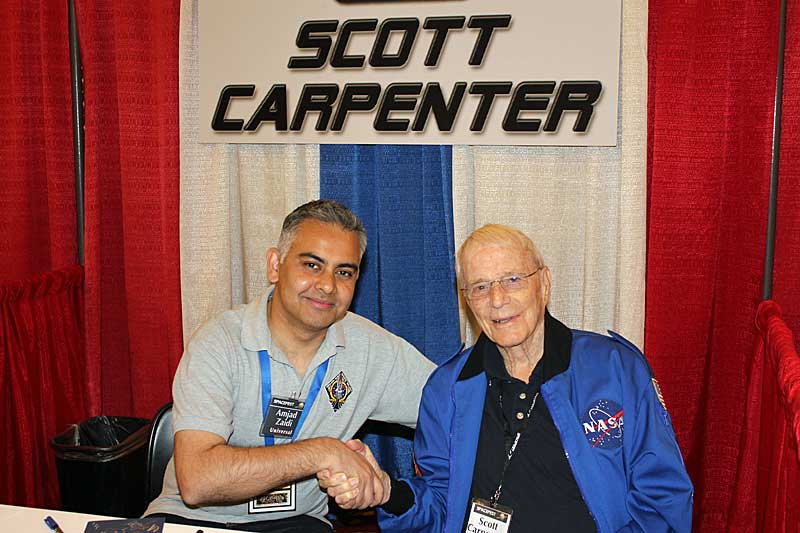
It is with bittersweet
humility I write to you
following the passing of
Scott Carpenter. I recently
met him at Spacefest V in
May this year and found him
to be gracious and curious,
despite his ailing health.
As I knew he would, he
impressed me greatly.
Obviously this may have been
one of the last events he
attended before his stroke.
This was a long standing
dream to meet him as a link
to the Original Seven and
one of my earliest heroes.
Over the years I have found
your site to be a
wonderfully put together
library and a touching
tribute to Scott's life. As
I am a STEM and Space
Exploration outreach
ambassador I have written a
few articles which might be
of interest to you relating
to Spacefest V and Scott.
RocketSTEM magazine has my
account of Spacefest V including
my meeting with Scott in its
current issue.
Naturally coming so soon
after that then hearing
about his loss, I wanted to
write a special tribute to
him.
My article at the Space
Tweep Society is my way of
saying thank you to him for
his on-going inspiration,
and to credit your wonderful
site too. Paying it forward
is the nature of volunteer
outreach efforts and so I
wanted to share this with
you, his followers, friends
and most of all his family.
To let them know he was
admired and loved the world
over.
I hope his family one day
will be able to appreciate
the many tributes (including
my own) that have been paid
to Scott. He will be missed
but his presence helped
galvanize not only myself
but many others to pursue
our spaceflight dreams and
the push to continue our
adventurous reaches into
space.
With kind regards,
~Amjad
Z.
I've
met Scott Carpenter on several occasions during my
many visits to Kennedy Space Center, and a few times
at events at other venues. One very special time was
when I was at KSC for another Hall of Fame induction
weekend in 2003. Besides Carpenter, other astronauts
in attendance were Jim Lovell and Fred Haise of
Apollo 13, and Moonwalkers Ed Mitchell and John
Young. Mercury astronauts John Glenn and Gordon
Cooper were also there. Meeting any astronaut is
always exciting, but meeting one of the original 7
is really something. And I met three of the
surviving four there that night, all in the same
room. Wally Schirra did not attend that year. As we
were being slowly ushered out of the room I asked
Carpenter if he'd mind if I could get a photo with
him and Gordon Cooper. At that time Glenn had
already left the room. Carpenter was happy to, so I
quickly asked Cooper the same. "Sure," he
said in his slow southern drawl. So there I was,
standing between two of the first seven American
astronauts. Click. I've had my photo taken with a
lot of astronauts, but this one is my absolute
favorite.
Carpenter is probably the astronaut I have met the
most. I met him at least enough to where he actually
remembered me. On May 1, 2004 Carpenter was signing
autographs at the Kennedy Space Center Visitor
Complex and while standing in line I overheard
someone a few people ahead of me say that they
thought it might be Carpenter's birthday. This
person said nothing about it when they met him at
his table. When I finally approached the table I
said hello and shook his hand. While Carpenter was
busy signing the photo I had brought I asked quietly
if it's possible that today was his birthday. I'll
never forget that moment. I could see the wide grin
forming even before he raised his head. Through a
big beautiful smile he said, "Yes. It is. I'm
79!" Everyone in line heard him and I'm sure
that he got well wishes from the rest of them. I
wished him a very happy birthday and asked if I
could get my photo taken with him, to which he
obliged. He asked me if I was from England. I told
him I was from southeast Georgia, less than 4 hours
north of KSC. He then asked me about myself and we
talked about my trips to the space center. I again
wished him a happy birthday and thanked him for
taking the time to be there on his special day.
It must have been about a year to a year and a half
later when I met Carpenter at the space center
again. When I showed him the photo of us taken
previously I asked if he remembered it. And he did -
"That was on my birthday!" He couldn't
remember which birthday, but he said he remembered
talking to me then and that he remembered my accent.
Now, over my years I've been asked more than a few
times, and mainly by non-southerners, if I'm from
England. I know Southernese has a lot of different
dialects, so maybe that's what some people hear.
Anyway, he remembered. We talked a little and he was
happy to sign the photo of us taken on his birthday.
And speaking of birthdays, October 10 is my
birthday. Until now, there was no one I knew of who
had died on my birthday. With the passing of Scott
Carpenter that is no longer the case. From now on,
every birthday I have will remind me of him. But
maybe that's not so bad. True, today was a sad day
for many, including myself. But I suppose that when
I go it might be nice to also go on a day that won't
be forgotten by at least someone. It's good to be
remembered.
If there is one thing that I will always remember
about Scott Carpenter, it is his voice. Soft,
assuring, almost melodic. He had one of those voices
that you couldn't help but to love. You would love
to just listen. And to think, this gentle man once
braved the depths of oceans and strapped on a rocket
and blasted into space at a time when no one really
knew what would even happen. This gentle man did
that? I feel quite privileged to live in a time when
I can actually meet people like Scott Carpenter, the
pioneers, the modern day Columbus' and Magellans,
those with the right stuff. Carpenter once said,
"Curiosity is a thread that goes through all of my
activity. Satisfying curiosity ranks No. 2 in my
book behind conquering a fear." Good words from
a good man. Thank you, and Godspeed, Scott Carpenter
~RJ
My friend and I toured
the Museum of Science and Industry in Chicago Weds
Oct 08. First visit for me since the 1960's. Spent
several minutes at Aurora 7. Feel very spirited I am
able to remember the mission and now one of the
final people to view the capsule before Mr Carpenter
died. G-Dspeed to a great astronaut and American.
~Irwin S.
I am
saddened to hear about Col. Carpenter's passing. My
sincere condolences. The original seven Mercury
astronauts were my first true heroes. Though the
years, every time a documentary came on featuring
them, I was there in front of the set, eager to hear
about their exploits and what they've done in later
years.
Scott Carpenter epitomized courage, tenacity,
strength, intelligence and grace. He was a great
gift to us.
~Martha
Y.
The
death of astronaut Scott Carpenter makes me very
sad.
First, I would like to express my condolence to his
family.
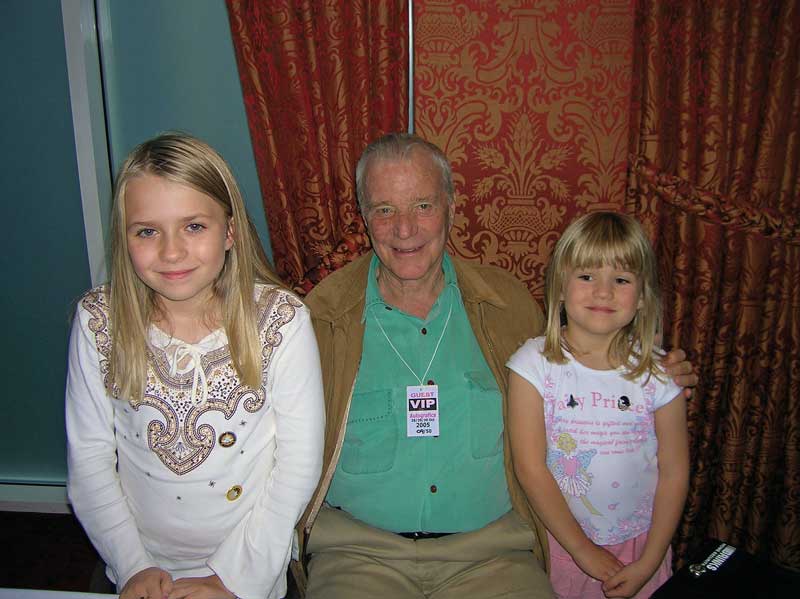
I had the great fortune to meet Scott in person
twice. On October, 29th, 2005 and on June, 3rd,
2006, I met astronaut Scott Carpenter at"
Autographica " in London. Both meetings will remain
unforgettable for me, because Scott and I always had
intensive conversations with each other. And we had
become good friends in these two meetings. Scott was
a special person and of course I was still hoping
for further encounters with him.
Now he's gone and I want to remember to Scott with
the photo of our meeting on June, 3rd, 2006.
Scott, you will always be in my heart and your
kindness and warmth will remain unforgettable to me.
May you rest in peace, Scott. God bless you.
Your friend from Stuttgart in Germany,
~Helmut H.
Scott was so funny. He had come up for
our event in 1984 had a green Mercedes. He came
himself and he said after the event he had to go
home and mow the lawn to leave for Hawaii on
vacation.
~Mike C.
I met Scott years back at an shopping mall where
he was signing autographs. It was so odd getting
to meet a real astronaut.
~Annette P.
Nearly 20 years ago, I spent two wonderful hours with an old astronaut, Mr. Carpenter. I was a young news editor (and space geek) having a wonderful conversation with Mr. Carpenter about how we both missed the Russiansin the space race. He was waiting speak to a bunch of brainy kids getting awards at Great America in Gurnee, Ill. The management asked him and me if we'd like to ride the Batman ride in the
closed amusement park. Mr. Carpenter, with a broken
collarbone from a skiing accident and on the eve
of his 70th birthday, said, "Absolutely."
We took our seats on the ride, him in front of me. He kicked off his shoes just like he would have at a simulator in Houston. The ride took off. He was having a ball. Afterward, with an ear-to-ear grin, he said, "Now that was real!" He was a wonderfully human, earthy man. I wish we had more Americans
like him. He will be missed.
God speed, Mr. Carpenter!
~Ross W.
Sincere condolences to all Col.
Carpenter’s family and friends.
I had the great honour and
privilege to meet him a couple
of times at Autographica events
here in the UK.
Scott was always kind, patient
and attentive to all those
wishing to meet him and secure
his autograph. He was generous
with his time talking with me
about his Mercury mission and
his amazing subsequent career;
despite no doubt long hours
manning his signing desk. A true
pioneer and a real gentleman. He
will be missed on this side of
“the pond” too.
~Matthew S.
My condolences to the
Carpenter family. I'm so
glad I was able to meet Scott at
SpaceFest this year.
~Todd G.
I was born in 1960, and have
followed the Mercury 7
astronauts since I was old
enough to understand. To be
honest, John and Scott were
my favorites. :) I have been
totally blind for over 15
years now, but have
downloaded and read For
Spacious Skies, and many
other autobiographies of the
former astronauts. I held
Scott in a special place,
probably because he was also
an aquanaut. I also have had
to deal with hydrophobia. I
love how he attacked this
phobia head on by becoming a
diver. Being blind myself, I
doubt if this would be a
good idea for myself now. :)
Bill Taylor, who has worked
at NASA for over 50 years,
was supposed to get me a
personalized photo from
Scott for me. Sadly, that
never happened. Bill owed me
a favor, so I requested that
from him when he offered. :)
Sometimes we put things off
too long, and then it's
sadly too late. I'm very
guilty of that myself. :)
Again, my sympathies are
with Scott's family and
friends. I wish I would have
had the chance to know him
personally. I'm sure I would
have been the better for it.
God speed!!
~Curtis H.
I'd heard what a
down-to-earth guy Scott
was for years, from you
and from others, and
thoroughly enjoyed his
book.
I was particularly
intrigued by his
closeness to his
grandfather. With all
the exceptionally hard
work and hard times that
helped for him, Scott
was always particularly
close to his grandfather
and, after his
grandfather passed,
still was, apparently,
so influenced by him.
I did get to meet Scott
a a couple more times.
What intrigues me is
that the Omega Watch
appearance in
Winston-Salem with
Charlie Duke (Ed Buckbee
was there, too) was the
last time I saw him.
After chatting with him
awhile, I watched
closely when folks
brought their
grandchildren to meet
him.
Scott instantly
flipped from being
the Steely Eyed
Aviator to being a
grampa. He sweetly
picked up each and
every one of those
kids, gave the
parents as much time
as they need to take
photos, played peek
a boo and other
games with the
little ones, and
just was the
gentlest, kindest,
sweetest best grampa
in the world. Made
me wish I had
grandbabies I could
put in his lap, too!
That's the image I
keep in my mind of
Scott Carpenter--the
grampa who just
could not get enough
of those little
children climbing
all over him,
looking at patches
and things on his
suit, sticking
fingers in his
ears...he was as
much in his element
there--or more--than
in outer space or
under the sea.
A remarkable,
exceptional,
delightful human
being. Who also
happened to be an
astronaut and
aquanaut.
~Susan K.
My sincerest
condolences on his
passing. Though I
only met him twice,
once in 1961, at the
Holiday Inn in Cocoa
Beach, and years
later, at his book
signing on
publication of “For
Spacious Skies”, he
was a hero to me,
and, I’m sure many,
many others. Thanks
for his service.
Rest in Peace!
Sincerely,
~James B
I
was fortunate enough
to meet Mr. Carpenter
at KSC in the summer
of 2006. As fellow
scuba divers, we had
much in common and I
enjoyed our meeting
tremendously.
~Beate C.
I
became a teenager in
1960 and watched
every Mercury,
Gemini, and Apollo
launch an every bit
of ‘live’ telecast
available in the
Midwestern Plains.
We were fortunate
that the nuns of our
small Catholic
school believed we
HAD to witness
history and
permitted us to
watch these events
on their TV. In
1961, I even skipped
public school
classes to watch at
home.
We
had it drilled into
us by these nuns
that space was our
future and we held
to that.
The
“Original Seven”
were our heroes,
and, as we lose one
we are all
lessened. I found
out today that
Astronaut Carpenter
had passed and I am
lessened by this
loss.
True
Americans are proud
of the courage,
patriotism, and
accomplishments of
the “Original
Seven.” RIP.
~Henry S.
You
and your fellow
astronauts are and
will always be my
heroes. You
inspired my
generation with your
dedication,
perseverance
and hard work to
accomplish
what
many thought was an
impossible dream of
landing a man on the
Moon. You and your
fellow astronauts
showed this country
what truly means to
be an American.
Rest in peace. and
God Bless you!
~Ali S.
I met
Scott Carpenter in Seabrook, Texas in February 1990.
I had become friends with one of the Shuttle Flight
Trainers at Johnson Space Center in Houston. He and
his training team used to come see my band when we
were in town. In turns out space people want to be
rock musicians and rock musicians want to be space
people. This guy’s dad (Bill Todd, Sr. – Dee, you
may have known him) was best friends with Scott when
the two of them were growing up in Boulder, CO. In
fact, there’s a picture of the guy’s dad with Scott
working on an old car in LIFE Magazine when LIFE was
doing a story about Scott’s upcoming flight. Well,
they remained lifelong friends with each other,
including Bill, Jr., who was my newfound friend.
Bill used to invite me down to JSC on Wednesday
nights, when I wasn’t on the road, to play his
“victim” in the Space Shuttle simulator as he set up
the next day’s “nits” & “malfs” for the crew he was
currently training. I’ve got some great video
footage of us in the trainer while I’m trying to fix
bad things going on and Billy explaining to me why
I’m getting ready to make a new and very expensive
hole in the ground! On one such Wednesday, Bill
asked me come a little early, around 3pm. Now,
anyone who’s driven down I-45 South from downtown
Houston at 3pm can tell you it’s slow going. I
finally got to Billy’s house in Seabrook, a modest
little neighborhood just across from JSC where many
astronauts lived with their families during their
mission training. I went to the back door as usual,
Billy answered and said “Hey, go have a seat in the
den and I’ll bring us some iced tea.” I walked into
Billy’s den and there’s this short, gray haired guy
sitting on the sofa. I looked at him and suddenly
realized – hey! That’s Scott Carpenter! Having met a
number of “famous” musicians in my life, I knew just
how to act. I walked up to him, he stood up and he
said “Hey, you’re Bruce Moody, aren’t you?!” He
stole my line! I was dumbfounded!
I finally managed to say “I’ve been wanting to
meet you since I was about 6 years old!” and he said
“Thanks. You really know how to hurt a guy!”
Immediately, he started asking me about my music, my
band, the recording process and, of course, the
wake-up song we were working on through Billy for
STS-31. I couldn’t get a word in edgewise about
“Mercury” or “Aurora 7”. Finally, it was time to
head over to the space center to learn more about
fuel cells and to also learn why it’s bad idea to
come up short at the HAC when you’re lining up to
land at KSC at the end of a Shuttle mission. The HAC
is the Heading Alignment Cone, which is a big
300-degree turn that the shuttle makes to accomplish
energy management (see = “slow down!”).
Over the years, Scott and I kept in touch
sporadically, finally seeing each other in person at
an autograph show in Washington DC in 2002 or 2003,
I believe. But my favorite time with Scott was the
long weekend in 2008 when the two of us went to
visit Cece Bibby. Cece was the artist who painted
the insignias on the spacecraft’s of John Glenn
(Friendship 7), Scott Carpenter (Aurora 7) and Wally
Schirra (Sigma 7). Cece was living in a very nice
retirement community in Hiawassee, Georgia since
recovering from her recent stroke. Scott and I had
discussed the possibility of going to visit Cece at
some point if his schedule ever brought him to the
Carolinas area. Scott called me one afternoon to say
that he and Charlie Duke were doing an Omega watch
joint appearance the at the hotel in Winston-Salem,
NC, not too far from me and “sort of” in the area
close to Cece. This seemed like a nice window of
opportunity to accomplish our visit to Cece.
After spending a week of so working out the
details over the phone with Scott, it was decided
that I’d pick Scott up at the Winston-Salem, NC
hotel on a Saturday morning at 7am and then the two
of us would drive to Cece’s place from there.
Now, Hiawassee, GA is in the mountains of
Georgia, sort of tucked into the lower SW corner of
North Carolina and NE corner of Georgia. The route
is filled with a lot of those “you can’t get there
from here” roads. No worries. I had an 8-page
MapQuest printout (!) for our 5-hour drive and a
list of questions memorized for my trapped guest of
honor. As many of you know, it’s nearly impossible
to get Scott to talk about himself, so we talked
about his early recollections of Cece, Dee, the Cape
and, of yes, the other “astronauts” as they were
exclusively known at the time. I will tell you all
here and now that when I asked him if Gordo Cooper
was “the best pilot you ever saw”, Scott said “No,
he wasn’t the best. Probably of the seven of us,
it’d be a tie between Al and Gus for pure pilot
instinct and skill. Amongst the rest of us, it was
probably a tie.” Wow! That only took 18 years and 3
hours of winding mountain roads, but it was worth
it!
The best part of the trip was just hanging out
with Scott. He was so curious about learning. He
really got into trying to identifying the different
trees and flowers along the beautiful North Carolina
mountain roads! When we first arrived at Cece’s
place, she had told the staff that Mercury astronaut
Scott Carpenter was coming. The center’s staff met
us in the lobby and took us to a private dining room
for a special lunch. Cece was overjoyed to see Scott
and you could just sense the fondness the two had
for each other. Luckily, with Cece’s stroke, her
long-term memory wasn’t affected at all at that time
and the two of them reminisced for a long time. It
was a great time to be a fly on the wall and enjoy
my strawberry shortcake at the same time! Cece
reminded Scott about the pranks Gordon Cooper played
on her, and the big one she played on him (something
about carrot cake), and the time Alan Shepard
“demanded” to drive her precious British race car
and she turned him down. There was also the time
Cece, having enough of being pushed around while she
tried to get her work done on Scott’s spacecraft
painted a big red “X” on Guenter Wendt’s white
overalls, or as Cece told it imitating Guenter’s
German accent, “ven he vas trying to get me off ze
gantry in ze high vinds dat ver blowingk in from ze
coast!” Why didn’t I record any of this?
But mostly, I will always remember Scott’s
kindness to Cece and to the other people that he met
over that weekend. We took Cece out for dinner that
night and for lunch the next day before we left.
During our time at the center, they were a lot of
older folks who remembered Scott’s Mercury flight as
well as that most interesting time in our nation’s
history. I was very young at the time of Scott’s
flight (7 years old), but I have a “sense” of what
America was all about at that time and I realized
that Carpenter was an Ambassador of that time to
these people. He very patiently went through many of
the questions, answers and stories he’d gone through
thousands of times over the years for these people,
just like it was the first time. He was an
intriguing storyteller. He signed about 30
autographs. It just so happened that I brought along
some photographs and Sharpies with me! When we left,
Cece told me she now had “bragging rights” for the
next year! It was the happiest I’d ever seen her and
it was great watching these two old friends make
time stand still for a few priceless hours.
I had to get Scott to the airport in Greensboro,
NC the next day for a 4pm flight to Chicago, so
after lunch with Cece, it was back in the car for
our now 4 hour journey out of the mountains and on
to Greensboro. I did ask him about going to the Moon
and to Mars and he told me that, at the time of his
and John’s flights, it was obvious we would get to
the Moon and to Mars, but at the time he thought it
might not happen until the mid-1980’s! When I asked
who he would have liked to have gone to the Moon
with, he said “Probably John or Gus”. When I asked
him why, he said “Because I would have wanted to
come back to Earth when we were done.” For what it’s
worth!
Moments after dropping Scott off at the
Greensboro airport, I phoned his daughter Kris in
Colorado to let her know I’d safely delivered him
there, that all was well and that his “sheen was
still intact”, which she thought was hilarious.
Knowing Scott Carpenter was very easy. It was his
kindness, his curiosity and his gentle nature that
allowed him to interact with anyone and make them
feel special. Those who came in contact with him
instantly recognized that there was a rare gift of
pure humanity in Malcolm Scott Carpenter.
After Scott lifted off on his last trip from
Earth to the heavens on October 10, 2013, I was
reminded of what Daniel Patrick Moynihan had once
said about JFK after that terrible day in Dallas.
“We will laugh again, it's just that we'll never be
young again.”
~Bruce M.
My husband and I attended our first autograph show
over 10 years ago and Scott Carpenter was one of the
astronauts in attendance; it was a small venue and
the lines were long. By the time that I got up to
him, I did not think that he would have time to say
anything other than, "Who would you like this made
out to?" I was very surprised when he took the time
to interact and ask me a question. I was star
struck and felt like a deer in the headlights, and
was only able to squeak out a quick reply. Of
course, as soon as I left, I thought of a million
things I should have said.
Years later, I was seated next to him at a dinner.
Thankfully, unlike our first meeting, our
conversation was easy and relaxed and I thoroughly
enjoyed getting to know this incredible man.
Throughout the years, my husband and I routinely saw
him at the AHOFinductions and at the AAMS events.
He always greeted us warmly and being able to
interact with him was always special. This
particular picture was taken at the Mercury 50th
Anniversary event.
He was a true hero and was also one of the nicest
people that you could meet. We were so fortunate to
have had the opportunity to meet him and will always
cherish our interactions and conversations.
God Speed, Scott Carpenter. We will miss you.
~Mary M.
In common with many
children of the 1950’s, I had memorized the names of
the Mercury 7 astronauts and their spacecraft and
even knew how many orbits they flew. In 1966 I began
a friendship with a NASA astronomer depicted in
Scott Carpenter’s memoir, For Spacious
Skies: Jocelyn Ruth Gill, PhD (1916–84), chief
of in-flight sciences for the early manned
spaceflight program. She knew all of the Mercury
astronauts but told me of her special relationship
to Commander Carpenter because of his exceptional
interest in exploiting the manned missions for
scientific purposes. In fact, in 1962
National Geographic published an article on an
airborne solar eclipse expedition which included
among its scientific crew both Dr. Gill and
Commander Carpenter. Remembering Gill’s compliments
about Scott Carpenter’s scientific acumen, many
years later I sent a query to this website asking if
he would contribute a foreword about the value of
celestial navigation for a book on the history of
maritime navigation. To my delight, he promptly
replied in the affirmative and we arranged a
telephone interview. The discussion touched on his
recollections about Gill and about flying Navy
patrol missions over the Pacific decades ago. He
greatly valued his skill at navigation—which, as he
pointed out, once learned, remained a skill for
life—but he impressed me with his self-effacing
attitude towards his own early ignorance and
overconfidence in navigating aircraft. He was once
so confident in his own abilities, he recalled, that
on patrol he got lost because he left his aircraft
sextant behind. With only endless sea below, he had
to fly a search pattern for hours to locate Guam. He
was generous in entertaining my questions and
provided a foreword that was insightful, useful,
stimulated interest in navigation, and showed humor.
From my admiration of him a half century ago to his
contribution of a foreword to my book, I have
followed his enviable, full career and am privileged
to have spoken with him about a subject of which he
was passionate.
~ Dr. Robert H.
I NEVER MET SCOTT
CARPENTER
I never met Scott Carpenter, but a
piece of his Aurora 7 heat shield
Rests proudly on my desk.
I never met Scott Carpenter, the
Mercury astronaut,
But I did meet all the rest.
Al Shepard, Deke Slayton, Gus Grissom,
Wally Schirra, Gordon Cooper. John
Glenn.
Scott Carpenter was a member of this
band;
A great man among great men.
Heat shield from “Aurora Seven”
Mercury Atlas-7 M. SCOTT CARPENTER
MAY 24, 1962
Reads the engraved metal plate on the
oaken base
Holding the cubic inch of charred heat
shield
That protected Mercury astronauts from
the incomprehensible
Heat generated during reentry into
Earth’s atmosphere.
While traversing this perilous
passage,
Scott Carpenter’s back was only inches
away from the heat,
But he had little time to think about
heat shield;
He had been through a very busy day,
And it was not over yet!
Aurora 7 had been planned as a science
flight.
He had experiments to run;
observations to make;
Some during the daytime, some during
the night.
He photographed the Earth from high
above;
Found it hard to change film while
wearing a space glove.
He watched liquids in crystal clear
glass spheres
As they danced through space in
weightless flight.
Looked for the fireworks near Woomera,
But the Australian clouds blocked his
sight.
He released the multi-color mylar
balloon,
But it did not fully inflate.
Only two of the five colors showed,
And in the end, it did not pull its
weight!
He was the first to eat solid space
food;
Tasted Good; but the crumbs drifted
away.
Described the beauty of “Airglow”
As it signaled the end of the day.
Watched the flattened Sun at its
setting;
Caught it on film as it disappeared.
Flew the spacecraft by the light of
the Moon;
Was impressed by how easily it
steered.
Tracked a star in the Big Dipper,
And with sunrise, John Glenn’s “Fire
Flies came.
He described them as more like
snowflakes,
And “Frost Flies” became their new
name.
With only one orbit left to go,
Flight notified him fuel consumption
was a concern.
He took his foot off the gas,
Coasted all way ‘round the Earth;
Got to reentry with plenty to burn!
At retrofire, the spacecraft heat
shield
Began to really earn its pay,
And it was most successful;
That’s why we have this small piece
today!
But not everything was going as well;
Scott Carpenter had problems to face.
When the Pitch Horizon Sensor again
malfunctioned,
Scott Carpenter took control of the
flight.
But the PHS failure pulled him
170 miles off course to the right.
Then he had to punch three retrofire
pulses
To bring the spacecraft safely home.
But with malfunctions and slow firing
retros,
He was 250 miles from the planned
landing zone.
Ships, planes, and choppers
All headed out to find the lost man.
Forty minutes later, he was spotted by
aircraft;
In a raft, next to his spacecraft,
treading water,
Relaxed and workin’ on a tan!
Scott Carpenter never flew again in
space.
He took leave from NASA and headed
straight for the sea.
There he trained in the Navy SEALAB
program
And appeared happy as happy could be!
Soon opportunity came and knocked on
his door,
And he spent a month off the
California coast
Living and working on the ocean floor.
Scott Carpenter sailed boldly
Into This New Oceanof
space.
Then he returned to Earth and dived
To the depths of her old oceans.
Astronaut—Aquanaut
One of a kind
A most unique individual
A man for all time!
On my desk, the heat shield from
Aurora 7
Anchors a row that holds two other
pieces of heat shield.
Next to Aurora 7 stands heat shield
from Gemini VIII
Launched March 16, 1966 and flown by
Neil Armstrong and David Scott.
I did meet both of them.
At the end of the row is heat shield
from AS-503,
An unmanned flight test of the Apollo
Saturn system.
The identification plate holds my
name.
It was presented to me in February
1967
When I traveled to the heat shield
manufacturing plant
To thank them for the good work they
were doing
In support of the NASA lunar landing
missions.
The gift was a most pleasant surprise!
These three small treasures from
Mercury, Gemini, and Apollo
Have been in my possession for nearly
50 years,
And thousands have viewed, questioned,
and touched.
The collection has been shared,
And I have guarded them well.
On October 10, 2013, Scott Carpenter
passed away.
When I heard the announcement of his
death,
I sat at my desk and spent time with
his heat shield.
These words I now share with you
Began to take form in my mind.
In the following weeks as I reviewed
his life and career,
A feeling emerged within me.
Although his body had been laid to
rest,
I felt Scott Carpenter’s spirit was
very much alive;
It surrounds us!
On land, in the oceans, in the air, in
space;
All environs in which he performed at
the highest level,
His spirit touches others as they seek
to reach and extend.
I feel this is the mission of Scott
Carpenter’s undying spirit.
I still regret never meeting Scott
Carpenter;
However, I do believe I am coming to
know his spirit.
This feeling brings me comfort and
great hope.
In closing, I borrow a word from Scott
Carpenter;
A word he spoke as Capcom on the
flight of John Glenn.


















 I've
had the pleasure of working with Scott Carpenter for
several years, both as his webmaster and his friend.
I've been lucky enough to befriend many of the
"golden age" astronauts as well as their support
staff. Along with Scott, I had the pleasure of
getting to know Gordon Cooper and Wally Schirra.
Scott, Wally and Gordo were magnificent men who flew
into the unknown simply to go higher, faster and
farther than anyone else. The greatest group of
gentleman that it was my pleasure to meet and get to
know.
I've
had the pleasure of working with Scott Carpenter for
several years, both as his webmaster and his friend.
I've been lucky enough to befriend many of the
"golden age" astronauts as well as their support
staff. Along with Scott, I had the pleasure of
getting to know Gordon Cooper and Wally Schirra.
Scott, Wally and Gordo were magnificent men who flew
into the unknown simply to go higher, faster and
farther than anyone else. The greatest group of
gentleman that it was my pleasure to meet and get to
know.