ICON CORNER: Scott
Carpenter’s late 1959/early 1960 Gretsch #6117 Double
Anniversary
Serial #34374
By Willie G. Moseley
During the 1960s, the
astronauts were bigger than the Beatles…and no, I’m not
referring to the Boulder, Colorado-based surf band that
snagged the interest of budding guitarists early in that
decade with songs like “Baja”, but curiously, Boulder
actually figures into the history of this instrument.
A member of homo
sapiens made the first voyage into outer space in
April of 1961, and slightly over eight years later,
human footprints were left on the surface of the Moon
during the first of six landings. The efforts of the
astronauts of the Mercury, Gemini, and Apollo space
programs were covered in detail by media worldwide, as
the United States and the Soviet Union duked it out in
that decade’s fabled “Space Race”. In particular, the
original seven Mercury astronauts had an almost
deity-like stature among the press and the general
public, as chronicled in Tom Wolfe’s The Right Stuff
and other tomes.
And one of the Mercury
Seven, U.S. Navy Commander Scott Carpenter (born in
Boulder in 1925), owned and played this guitar in the
early ‘60s.
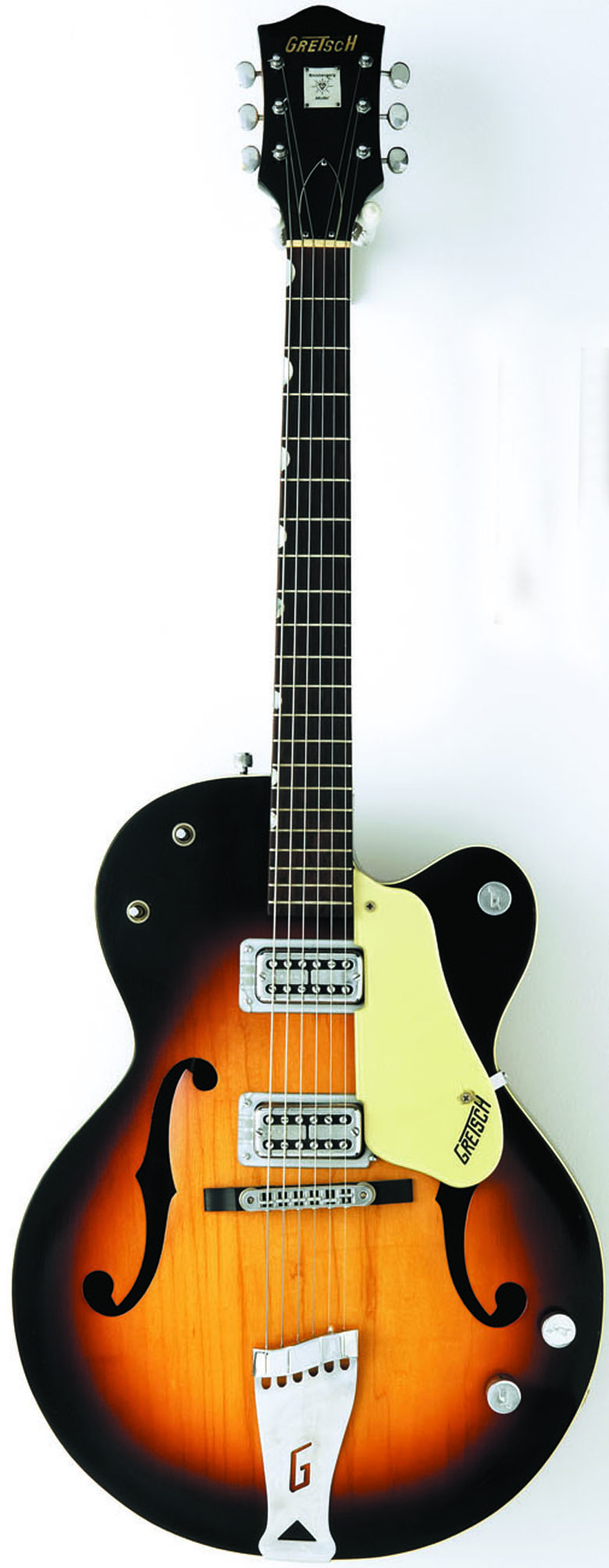
It’s a
first-configuration Gretsch 6117 Double Anniversary, and
its serial number indicates that it was made in late
1959 or early 1960. Carpenter, now 80, recently told
Vintage Guitar about his affection for folk and
Calypso music in such times (citing tunes such as
“Yellow Bird” and “Day-O”), and he also recalled his
introduction to guitar.
“I was attending the
University of Colorado Engineering School,” Carpenter
recounted, “and I went home with a classmate one
afternoon; he had a guitar and knew how to make three
chords, and I was hooked. I had several guitars,
including a Martin, and a bunch of other stringed
instruments---ukeleles and a tiple, which I loved.”
Regarding his purchase of
this instrument, the astronaut recalled that he
purchased it in New York City when he and his wife Rene
were in town to see a Broadway play, and that
fellow Mercury astronaut John Glenn and his wife Annie
were with them.
Collective recollections
indicate that the purchase probably took place in the
fall of 1960. After attending a matinee performance of
The Miracle Worker at the Playhouse Theater, the
playgoers made a quick jaunt up 48th St. to Manny‘s
Music just before it closed so Carpenter could make his
purchase.
“I don’t know why I
decided on a Gretsch Anniversary,” he said. “I guess I
thought at the time I was getting the top-of-the-line,
and it’s a well-made instrument.”
Carpenter admired the
two-pickup guitar’s “unplugged” sound, noting “I felt it
did well without ‘being electric’.”
Debuting in 1958, the
75th annum of Gretsch’s history, the Anniversary series
consisted of the single-pickup 6124 model and the 6117
two-pickup version in sunburst, as well as both
configurations in a “Smoke Green” color (one-pickup =
6125, two-pickup = 6118).
Specs for Anniversary
models included a 16”-wide single-cutaway maple body
that was 2 ½” deep, and an ebony fretboard with
“thumbprint” fret markers. The headstock features a
small “Anniversary” plaque with a diamond logo etched
into it.
Like many Gretsch
instruments, the Anniversary series went through
numerous changes in its history. The original
twelve-polepiece Filter’Tron pickups that appeared on
first-configuration models were supplanted by
less-potent-therefore-less-desirable Hi-Lo’Tron pickups
soon after this example was made, and the series
ultimately underwent other numerous alterations
concerning electronics, hardware and cosmetics.
The control layout of
first-edition Double Anniversarys is particularly
intriguing, however. Note the pickup toggle switch and
three-position tone switch on the upper bout, the master
volume control on the cutaway, and the individual pickup
volume controls on the lower bout. The bottom-line
revelation is that if this guitar was in an orange
finish, and had a Gretsch “V” Bigsby vibrato instead of
a “G” tailpiece, it would be Gretsch’s flagship model
from the same era, the Chet Atkins model 6120.
This example has a
replacement tune-a-matic bridge, which is more
sonically-reliable than the original “Space Control”
bridge, which had six threaded wheels that allowed
string spacing but no intonation capability (details
momentarily).
Scott Carpenter was the
fourth American to venture into outer space, making his
three-orbit journey in Aurora 7 on May 24, 1962.
To put things into perspective, that’s almost 21 months
before the Beatles appeared on “The Ed Sullivan Show.”
Sadly, the space veteran
sustained an injury to his left arm in 1964 that forced
him to give up guitar.
“I can’t supinate my left
arm anymore,” he said. “I can’t make barre chords, but I
play four-string instruments on occasion, like a uke or
a tiple, so I can still join in the fun.”
Carpenter ultimately gave
the Gretsch to his younger daughter Candace, who
graduated from Berklee School of Music. Candy counted
the redoubtable Emily Remler (now deceased) among her
instructors, and now teaches guitar and utilizes the
6117 in her own jazz combo, the Jean Poole Trio, in the
Boulder area, where she and her father reside. She
stated that since the guitar has been in her possession,
the bridge has been replaced, a neck separation has been
repaired, and the instrument has been re-fretted.
Carpenter’s older
daughter, Kris, also resides in the Boulder area, and
collaborated with her father on his life story, For
Spacious Skies, published in 2003.
This Gretsch Double
Anniversary model is cool and collectible as is, but
it’s even more interesting due to its historic
association with a real-life legend (as opposed to a
music/entertainment legend).
The music of the Beatles
has endured over the decades, and while such longevity
should continue to be the case, the
literally-groundbreaking adventures of the early
astronauts have faded into the realm of history books
and cable TV shows. Say the name “Paul McCartney”, and
everyone will know who you’re talking about. Say the
name “Scott Carpenter”, and an explanation, either via
the internet or verbally (most likely from a Baby
Boomer) would probably be requisite.
Photo by Tim Tucker
(A tip of the headstock
to Kris Stoever and Candace Carpenter)
--------------------------
Willie G.
Moseley is the Senior Writer for
Vintage Guitar Magazine.
This article originally appeared in the
March 2006 issue of that publication, and is reprinted
by permission. Willie may be reached at [email protected]