Home | Contact Us

         Aurora 7 50th Anniversary Events


I had the extreme honor of being an invited guest to Cmdr. Carpenter's 50th anniversary celebration which was held at the Player's Club in NYC on the evening of May 23, 2012. I am presently trying to gather information from the professional and amateur photographers and videographers and musicians that were present. As soon as that is compiled, I hope that I am able to share one of the greatest evenings that it was my pleasure to attend. From the first moment until the very last, it was one class act - one that I'll never forget for the rest of my life. On a personal note, I would like to thank Scott and Patty Carpenter for including me on this historic night. If you were there, and took photos, please send them to me at [email protected] and I will make sure that they are posted. It was also a pleasure meeting the entire Carpenter "clan" and hearing some wonderful stories.

Keep on eye on this page for future photos and stories.

Tracy Kornfeld
Webmaster


Photo by Judith Smith


CU astronaut-alumnus Scott Carpenter looks back at 50th anniversary of Aurora 7 mission
by Staff Writers for CU News
Boulder CO (SPX) May 24, 2012
 

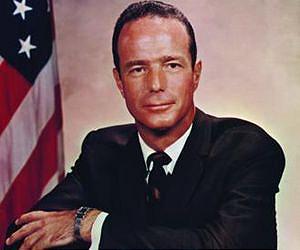
Scott Carpenter (Photo courtesy NASA).
On May 24, 1962, University of Colorado Boulder alumnus Scott Carpenter lifted off from Earth in NASA's Aurora 7 space capsule mounted atop a Mercury-Atlas rocket at Cape Canaveral, Fla., swiftly climbing to roughly 165 miles in altitude.

The NASA astronaut and his capsule were swept into Earth's orbit, eventually speeding around the planet at 17,000 miles per hour - a velocity roughly equal to flying from New York to Nepal and back in under 60 minutes. Carpenter, who attended CU-Boulder from 1945 through 1949 in the aeronautical engineering department, made three orbits of Earth in roughly five hours before splashing down in the Atlantic.

Carpenter was the fourth American astronaut to fly in space, following Alan Shepard, Gus Grissom and John Glenn, and the second to achieve orbit around Earth behind Glenn. As one of the "Original Mercury 7" astronauts, Carpenter made an indelible mark on history with the flight of the Aurora 7 mission. He and his colleagues were celebrated in the Tom Wolfe book, "The Right Stuff," which told the story of early military test pilots as well as the original Mercury astronauts.

A half-century later, Carpenter looked back at his time in space. "That seems like a long time ago," said Carpenter, now 87 and living in Vail. "I still remember what a thrill it was being up there - I liked the feeling of weightlessness, and the view I had of the Earth."

Carpenter will participate in two days of events May 23 and May 24 in New York City in honor of the 50th anniversary of NASA's Aurora 7 flight. The events, sponsored by the Astronaut Scholarship Foundation created by the Mercury 7 astronauts "will be a great honor for me," said Carpenter.

In February, Glenn and Carpenter - the only two living Mercury astronauts - attended a ceremony at Kennedy Space Center in Florida celebrating the 50th anniversary of the nation's first two orbital flights.

"Scott Carpenter is the epitome of all of the good things about the University of Colorado Boulder's leading role in probing the frontiers of space," said CU-Boulder Chancellor Philip DiStefano. "The 50th anniversary of his mission is a tribute to NASA's original Mercury 7 crew and to all of the NASA astronauts, including many associated with CU-Boulder, who have stood on their shoulders."

One of his most vivid memories during the Aurora 7 mission, Carpenter said, was his successful role as a sleuth. During Glenn's February 1962 orbiting mission, he reported seeing brightly lit particles swirling about outside the space capsule, which he dubbed "fireflies." The mysterious particles baffled not only Glenn, but also NASA engineers and scientists.

Carpenter observed the same type of fireflies outside the space capsule during the Aurora 7 flight. During the mission, he accidently banged on the capsule cabin wall, causing a swarm of the fireflies to appear through the window. Carpenter almost immediately identified them as tiny ice particles dislodged from the capsule's exterior shell, subsequently dubbing them harmless "frostflies." "I was particularly pleased that I was able to demystify John Glenn's 'fireflies,' " he said.

Born in Boulder on May 1, 1925, Carpenter grew up in a house at Seventh Street and Aurora Avenue, and graduated from Boulder High School in 1943. He then entered the Navy's V5 flight training program at CU-Boulder. He spent the next year training in California and Iowa, returning to Boulder in 1945 to study aeronautical engineering at CU for the next four years.

Carpenter was commissioned in the U.S. Navy in 1949 and flew a variety of missions during the Korean War. He attended Navy Test Pilot School in Maryland in 1954 and was assigned as an Air Intelligence Officer on the USS Hornet aircraft carrier. In April of 1959 he was selected by NASA to be an astronaut.

After serving as backup pilot for Glenn for America's first manned orbital space flight on Feb. 20, 1962, Carpenter got his own chance just three months later. At the end of the successful mission his space capsule landed in the Atlantic Ocean about 135 miles northeast of Puerto Rico. Soon after, he took congratulatory calls from President John F. Kennedy and Vice President Lyndon Johnson.

Although he was one course requirement short of graduating with a bachelor's degree in aeronautical engineering when he left CU in 1949, the university awarded him his degree in 1962 following the successful Aurora 7 flight. When presenting the degree to Carpenter, CU President Quigg Newton said "his subsequent training as an astronaut has more than made up for his deficiency in the subject of heat transfer."

In 1965 Carpenter took a leave of absence from NASA to participate in the Navy's Man-in-the-Sea Project as an "aquanaut" in the SEALAB II project off the coast of La Jolla, Calif.,

where he spent 30 days living and working on the ocean floor at a depth of more than 200 feet. While undersea he spoke by phone with astronauts Gordon Cooper and Pete Conrad as they sailed overhead during their eight-day Gemini 5 mission.

Because of his groundbreaking deep-sea diving experiences with the Navy, Carpenter is hailed by many to be the first person to conquer both outer and inner space.

In 1967 he became the Navy's director of aquanaut operations during the SEALAB III experiment. After retiring from the Navy in 1969, he founded and became CEO of Sea Sciences Inc., a venture capital corporation that developed programs aimed at enhanced use of ocean resources and improved health of the planet. He worked closely with noted diver and scientist Jacques Cousteau and members of his Calypso team, and subsequently dove in most of the world's oceans, including under Arctic ice.

Buoyed by his background in aerospace and ocean engineering, he also developed a career as a consultant to industry and the private sector, has lectured around the world, narrated television documentaries and written several books, including the 2002 New York Times best-seller, "For Spacious Skies: The Uncommon Journey of a Mercury Astronaut" co-authored with his daughter, Kris Stoever. Carpenter continues to travel, lecture and consult.

Carpenter's name and fame is synonymous with several Boulder landmarks, including Scott Carpenter Park and Pool and the Aurora 7 Elementary School.

"I'm very proud of my attendance at the University of Colorado," said Carpenter, the first of 19 CU astronaut-affiliates to fly in space. "And there was not a better home for me than Boulder."



Breitling introduces the Scott Carpenter 50th Anniversary Navitimer Cosmonaute Timepiece


in a limited edition of only 1962 timepieces. Visit www.breitling.com
click on photos to enlarge


News
 

24.05.2012

NAVITIMER COSMONAUTE
 

BREITLING CELEBRATES THE 50TH ANNIVERSARY OF THE FIRST SPACEGOING WRIST CHRONOGRAPH.

On May 24th 1962, a Breitling Navitimer chronograph became the first wrist instrument to share in the conquest of space by accompanying the Aurora 7 flight. To celebrate the 50th anniversary of this historical feat, the brand is launching into orbit a new Navitimer Cosmonaute equipped with a highperformance Manufacture Breitling movement, entirely developed and produced in the company workshops. This 1,962-piece limited edition is distinguished by its 24-hour display, its manualwinding mode – two nods to the original 1962 chronograph – as well as the Aurora 7 mission insignia engraved on the caseback. Navitimer Cosmonaute. The legend continues.

MAIDEN SPACE FLIGHT.

The early 1960s were all about the space race. The Americans launched the Mercury program intended to develop manned flights. They were looking for a high-performance, accurate and reliable chronograph capable of withstanding exceptional conditions. With this in mind, they naturally turned to Breitling, the “official supplier to world aviation” and a privileged partner of the finest hours in aeronautical history. The Navitimer, the cult pilot's watch created in 1952, with its famous circular slide rule serving to perform all operations relating to airborne navigation, naturally asserted itself as the ideal instrument in taking up this challenge. It successfully passed all the required tests, and on May 24th 1962, Lt Commander Scott Carpenter orbited the Earth three times aboard the Aurora 7 capsule. On his wrist was a Navitimer equipped with a 24-hour graduated scale serving to distinguish day from night – an absolute necessity in space. Mission accomplished. This was a major new token of recognition for Breitling, and this space conquest pioneer soon entered the brand's collections under the name of Cosmonaute.

THE ENGINE DRIVING THE ACCOMPLISHMENT.

The new Manufacture Breitling Caliber 02 powering the Navitimer Cosmonaute stands out by its 24-hour display and its manual-winding system – two distinctive features echoing the model that accompanied Scott Carpenter in orbiting the Earth. It was developed by the Breitling engineers and watchmakers based on Caliber 01, the world's best chronograph movement, and is endowed with all the assets of this exceptional “engine” – including an original column-wheel structure, maximum reliability, security and functionality, unfaltering sturdiness and exceptional precision confirmed by a chronometer certificate granted by the COSC (Swiss Official Chronometer Testing Institute). Issued in a 1,962-piece limited edition, the 50th anniversary Navitimer Cosmonaute features a black dial with silver counters. The dial motif is created using the refined “par épargne” process on a sterling silver base, thereby guaranteeing the peerless radiance and readability of the indications. In addition to the Aurora 7 mission insignia, the engraved caseback also carries a Celsius/Fahrenheit conversion scale – another detail faithful to the design of the vintage Navitimer models.


Front of 50th anniversary
embroidered patch
with hidden initials


\Back of patch with plastic
coated signature strip
[shipped product will not
contain watermark]


This design celebrates the upcoming 50th anniversary of Scott Carpenter’s Aurora 7 mission which was launched on May 24, 1962. The astronauts did not have mission patches in those days so to distinguish their mission, they gave their spacecraft radio call signs and had art painted on their spacecraft similar to the aircraft “nose art” made popular during World War II.

The original Aurora 7 art was painted by Cece Bibby. The four stars represent that Carpenter was the fourth American launched into space. The two stars together above represent the fact that he flew the second orbital mission. The three orbits of the mission are represented as well as the fact that Aurora 7 landed downrange upon re-entry. Along with Carpenter's name are a silver Mercury 7 emblem and gold Astronaut Symbol.

The patch is approximately 6” high and 3.5” wide with a hot-knife edge border. It is fully embroidered The predominate colors are Navy Blue background trimmed in gold as Commander Carpenter is a Naval Aviator.


This patch has been produced in a finite edition of 300 patches. Of these 300, only 62 [in honor of the launch year of 1962] will be made available in a numbered and autographed version along with a COA that includes the matching patch number. The balance will be available, numbered but unsigned, but will still be considered as part of a limited production run. Cmdr. Carpenter will NOT sign any blank patches at any public appearance. Once they are gone, they are gone. Cmdr. Carpenter's initials are stitched within the patch to verify authenticity of the 300 patches that have been produced.

This patch was personally commissioned by Cmdr. Carpenter through artist Tim Gagnon who, along with Jorge Cartes, designed this patch as a one time collectible to celebrate the 50th anniversary of his spaceflight. At the present time, Scott Carpenter and John Glenn are the only two astronauts to approach this milestone. Project Mercury was the first American manned spacecraft and was only flown by six astronauts - the last American astronauts to fly, alone, in space. This is truly a one of a kind collectible offered exclusively by Cmdr. Carpenter and not a major corporation that can crank out patch after patch for an unlimited amount of production runs.

Cmdr. Carpenter will be signing BOTH the patch and the COA, so you will get TWO autographs for $175. He will be signing the patch on the back along a special strip to hold his signature. If you want to order the unsigned version, it will be available for $15. The unsigned patches will also be numbered and issued with a different COA. The "hidden" initials will also add to the authenticity of this patch. However, only numbers 1-62 will be autographed by Cmdr. Carpenter and come with a COA also signed by Cmdr. Carpenter.

These patches are now ready for shipping. Cmdr. Carpenter has asked FarthestReaches.Com to distribute this patch for him, since time constraints and logistics will not allow him to do this himself.   Orders are  currently being taken at FarthestReaches.Com for both versions. This is the ONLY source to buy this patch directly from Cmdr. Carpenter. Early orders get the lowest numbers! Order early to make sure you actually get one as inventory is already low.

If you see this patch on ebay out of Malaysia for a ridiculously low price, don't buy it, it's a fake. Please report this person to ebay. There is only one authorized dealer - FarthestReaches.Com, which is US based. Don't get fooled into buying a cheap imitation.


Scott's "thank you" to Cece Bibby for designing
the Aurora 7 logo for his Mercury spacecraft


Copyright © 2010-2012 WOWIE Web Design All Rights Reserved