ABOUT SCOTT
SCOTT CARPENTER
NASA ASTRONAUT (Retired)
"About Scott" was written and updated on May 1, 2012 by Cmdr. Carpenter
on his 87th Birthday
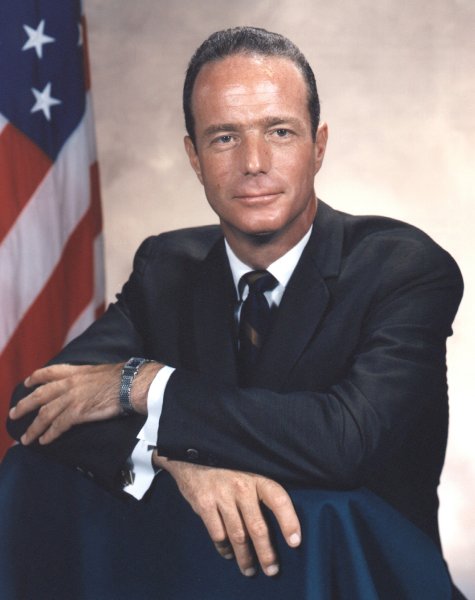 Scott Carpenter, a dynamic
pioneer of modern exploration, has the unique distinction of being the
first human ever to penetrate both inner and outer space, thereby
acquiring the dual title Astronaut/Aquanaut. Scott Carpenter, a dynamic
pioneer of modern exploration, has the unique distinction of being the
first human ever to penetrate both inner and outer space, thereby
acquiring the dual title Astronaut/Aquanaut.
Malcolm
Scott Carpenter was born on May 1, 1925, in Boulder, Colorado,
to parents Dr. Marion Scott Carpenter and Florence Kelso (Noxon)
Carpenter. His parents separated when his mother was
hospitalized with tuberculosis and he was raised by his maternal
grandparents. He attended primary and secondary school in
Boulder, graduating from high school in 1943. After one semester
at Colorado University in Boulder, Carpenter entered the Navy's
V-12a program at Colorado College in Colorado Springs. The
program was designed to give potential pilots advanced academic
training before they received basic experience in aircraft.
After a year there, he spent six months in training at St.
Mary's Preflight School, Moraga, California, and four months in
primary flight training at Ottumwa, Iowa. When the Navy's flight
training program ended at the close of World War II, Carpenter
entered the University of Colorado to major in aeronautical
engineering. He received a degree from CU in 1962.
Carpenter
rejoined the Navy and received flight training from November
1949 to April 1951 at Pensacola, Florida and Corpus Christi,
Texas. He spent three months in the Fleet Airborne Electronics
Training School, San Diego, California, and was in a Lockheed
P2V transitional training unit at Whidbey Island, Washington,
until October 1951.
 In
November 1951, he was assigned to Patrol Squadron 6 based at
Barbers Point, Hawaii. During the Korean conflict, he was with
Patrol Squadron 6 engaged in anti-submarine patrol, shipping
surveillance and aerial mining activities in the Yellow Sea,
South China Sea and the Formosa Straits. In 1954 he entered the
Navy Test Pilot School at the Naval Air Test Center, Patuxent
River, Maryland. After completion of his training, he was
assigned to the Electronics Test Division of the NATC. In this
assignment Carpenter conducted flight test projects in a variety
of Navy airplanes including multi- and single-engine jet
aircraft and propeller-driven fighters, attack planes, patrol
bombers and seaplanes. He then attended the Navy General Line
School at Monterey, California, for ten months in 1957 and the
Naval Air Intelligence School, Washington, DC for an additional
eight months in 1957 and 1958. In August 1958 he was assigned to
the USS Hornet, anti-submarine aircraft carrier, as Air
Intelligence Officer, where he was serving when he received
secret orders to report to Washington in connection with an
unspecified special project. Stopping in an airport on the way
to Washington, he picked up a Time magazine and learned that the
newly created National Aeronautics and Space Administration
(NASA) had identified 110 candidates, all military pilots, from
which to take volunteers for America's first manned venture into
space. It turned out that the unspecified project was the
reason for his secret orders. In
November 1951, he was assigned to Patrol Squadron 6 based at
Barbers Point, Hawaii. During the Korean conflict, he was with
Patrol Squadron 6 engaged in anti-submarine patrol, shipping
surveillance and aerial mining activities in the Yellow Sea,
South China Sea and the Formosa Straits. In 1954 he entered the
Navy Test Pilot School at the Naval Air Test Center, Patuxent
River, Maryland. After completion of his training, he was
assigned to the Electronics Test Division of the NATC. In this
assignment Carpenter conducted flight test projects in a variety
of Navy airplanes including multi- and single-engine jet
aircraft and propeller-driven fighters, attack planes, patrol
bombers and seaplanes. He then attended the Navy General Line
School at Monterey, California, for ten months in 1957 and the
Naval Air Intelligence School, Washington, DC for an additional
eight months in 1957 and 1958. In August 1958 he was assigned to
the USS Hornet, anti-submarine aircraft carrier, as Air
Intelligence Officer, where he was serving when he received
secret orders to report to Washington in connection with an
unspecified special project. Stopping in an airport on the way
to Washington, he picked up a Time magazine and learned that the
newly created National Aeronautics and Space Administration
(NASA) had identified 110 candidates, all military pilots, from
which to take volunteers for America's first manned venture into
space. It turned out that the unspecified project was the
reason for his secret orders.
 He
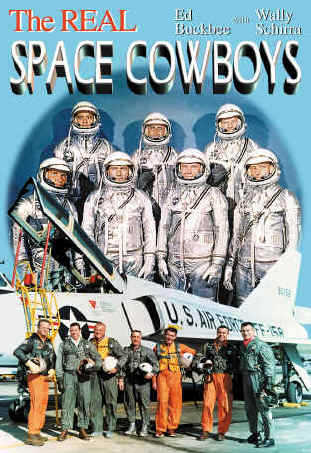
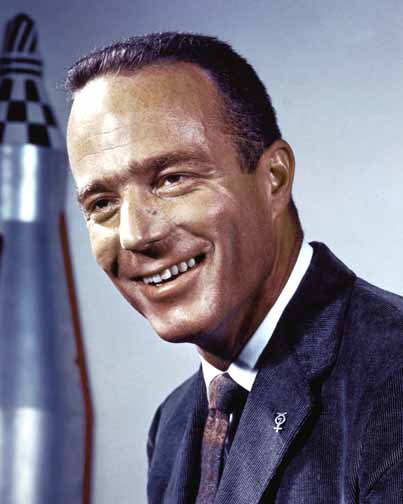
was chosen as one of the "Original Seven" Mercury astronauts,
and on April 9 1959, was assigned to the Manned Spacecraft
Center (then Space Task Group) at Langley Field, Virginia. Upon
reporting for duty, he was given a specialty area involving
communications and navigation because of his extensive prior
experience in those fields. He served as John Glenn's backup
pilot during pre-flight preparations for America's first manned
orbital flight, MA-6. He
was chosen as one of the "Original Seven" Mercury astronauts,
and on April 9 1959, was assigned to the Manned Spacecraft
Center (then Space Task Group) at Langley Field, Virginia. Upon
reporting for duty, he was given a specialty area involving
communications and navigation because of his extensive prior
experience in those fields. He served as John Glenn's backup
pilot during pre-flight preparations for America's first manned
orbital flight, MA-6.
When NASA
grounded MA-7 pilot Donald K. (Deke) Slayton due the idiopathic
atrial fibrillation of his heart. Carpenter was selected as
prime pilot for that mission with Walter M. Schirra, Jr., as his
backup pilot.
On May
24, 1962, Carpenter lifted off aboard the spacecraft he dubbed
Aurora 7 sitting atop the Mercury-Atlas 7 rocket. His spacecraft
attained a maximum altitude (apogee) of 164 miles and an orbital
velocity of 17, 532 miles per hour. His primary goal during the
three-orbit mission was to determine whether an astronaut could
work in space, a major stepping stone towards a lunar landing.
The flight plan included numerous scientific experiments,
including observations of flares fired on Earth and the
deployment of a tethered balloon. The balloon deployment was an
important experiment, to measure the drag of the balloon in the
very thin atmosphere and observe its behavior, its distance from
the capsule and the various colors it was painted. But the
balloon did not inflate properly and it took longer than was
expected for it to reach the end of its 100-foot nylon tether.
Carpenter was, however, able to judge its colors—the orange
being the most visible, which was a clue NASA used for painting
objects necessary for orbital rendezvous procedures. It was
impossible for Carpenter to measure drag of the balloon and it
proved to be extremely difficult to jettison once the experiment
was concluded. The switch that was meant to release the balloon
did not operate and Aurora 7 continued to trail the balloon
until retro-fire. While this experiment was underway both the
cabin and suit temperature control systems began to malfunction
and the cabin temperature went up to 160 degrees before it could
be brought back under control.
During
the first pass over Australia, Carpenter inadvertently neglected
to shut off one attitude control system when switching to
another, and doubled, for a time, the fuel expenditure. The
resulting fuel state became critical during reentry. During the
rest of the flight he fell further and further behind the flight
plan, which he said later was much too ambitious.
While
over Hawaii just prior to the preparation for retro fire, the
mysterious luminous particles, which John Glenn had seen and
called fireflies; began to appear in the window, which looked
back at the flight path. Carpenter's maneuvers and investigation
proved them to be ice particles formed on the outside of the
capsule by the frozen water vapor that was vented to the vacuum
of space by the cabin cooling system.
At the
time of retro-fire, Carpenter believed that he had brought the
capsule to the proper attitude. He found out later that this was
not correct. The small end of the capsule was canted 25 degrees
to the right of where it should have been, an error in yaw of
which he was unaware, due to the intermittent failure of the
horizon scanner and the associated attitude indicators. This
meant that when the rockets fired, the capsule was not pointed
in an absolute straight line along its path and so it did not
slow down as much as it should have. This accounted for 175
miles of the 250-mile overshoot. But several other things went
wrong in addition to that. First, the retrorockets did not
deliver the full thrust that was expected of them. This loss of
thrust accounted for 60 miles of the overshoot, and on top of
all this, the three retros fired approximately three seconds
late. They were designed to fire automatically, but they did
not. Carpenter watched the clock pass the correct instant, and
then depressed the retro-button himself a second later. Two
seconds passed before they finally went off and at a speed of 5
miles per second, the lapse of three seconds accounted for
another 15 miles in the overshoot.
 In
between the time of retrorocket firing and the moment Aurora 7
began its entry through the atmosphere, things were "pretty
tight," as Carpenter puts it. The fuel supply was critically
low, and it was unclear as to whether or not there would be
enough fuel to keep the capsule in the proper trim for the long
glide back to Earth. If it came through at the wrong angle and
the fuel was exhausted, Carpenter would have been unable to
control the capsule during descent and the chances of surviving
such a reentry were not good. He learned that though the manual
tank still registered 7 percent, it was really empty, and only
15 percent of the fuel supply remained in the automatic tank for
the whole reentry. He was dangerously short. In
between the time of retrorocket firing and the moment Aurora 7
began its entry through the atmosphere, things were "pretty
tight," as Carpenter puts it. The fuel supply was critically
low, and it was unclear as to whether or not there would be
enough fuel to keep the capsule in the proper trim for the long
glide back to Earth. If it came through at the wrong angle and
the fuel was exhausted, Carpenter would have been unable to
control the capsule during descent and the chances of surviving
such a reentry were not good. He learned that though the manual
tank still registered 7 percent, it was really empty, and only
15 percent of the fuel supply remained in the automatic tank for
the whole reentry. He was dangerously short.
Carpenter
maneuvered the capsule gingerly, keeping the horizon in view
through the window, and trying to use as little fuel as
possible. He held the position steady and when he felt the first
oscillations he knew that the capsule was encountering the
denser atmosphere. They were welcome however, because they meant
that aerodynamic pressures were being exerted against the
capsule and would help keep it on an even keel on the way down.
 Except
for the overshoot it was a nominal reentry. The ride most of
the way was smooth and Carpenter and his Aurora 7 spacecraft
were headed in at a good angle. When he glanced out the window,
Carpenter noticed an orange ring of fiery particles stretching
out like a wake behind the capsule. These were tiny pieces of
the ablative heatshield which had melted off and were carrying
some of the intense heat away with them. The peak Gs lasted
longer than expected and on the way down he had to inhale more
deeply and more frequently. The G forces tapered off at 120,000
feet, and the capsule and Carpenter were falling approximately
600 miles per hour. The oscillations built up rapidly and
Carpenter used the very last of his fuel trying to control it,
he was concerned that the capsule might topple over completely
and start coming down topside first. If this were to happen the
drogue parachute could get fouled, and unable to pull out the
main chute. The oscillations finally began to diminish and at
26,000 feet, Carpenter pressed the button to deploy the drogue
chute. The flight plan called for the drogue to be deployed
automatically at 21,000 feet, however Carpenter felt he needed
it sooner to help damp the remaining oscillations. The six-foot
drogue came out in good shape, and the descent stabilized. The
altimeter swung towards 10,000 feet, the point at which the main
chute was supposed to come out automatically. When it did not,
Carpenter allowed 500 feet more and then pulled the ring. It
deployed perfectly, an orange and white canopy, perfectly
shaped, and drawn tight as it began to support the capsule's
weight. Except
for the overshoot it was a nominal reentry. The ride most of
the way was smooth and Carpenter and his Aurora 7 spacecraft
were headed in at a good angle. When he glanced out the window,
Carpenter noticed an orange ring of fiery particles stretching
out like a wake behind the capsule. These were tiny pieces of
the ablative heatshield which had melted off and were carrying
some of the intense heat away with them. The peak Gs lasted
longer than expected and on the way down he had to inhale more
deeply and more frequently. The G forces tapered off at 120,000
feet, and the capsule and Carpenter were falling approximately
600 miles per hour. The oscillations built up rapidly and
Carpenter used the very last of his fuel trying to control it,
he was concerned that the capsule might topple over completely
and start coming down topside first. If this were to happen the
drogue parachute could get fouled, and unable to pull out the
main chute. The oscillations finally began to diminish and at
26,000 feet, Carpenter pressed the button to deploy the drogue
chute. The flight plan called for the drogue to be deployed
automatically at 21,000 feet, however Carpenter felt he needed
it sooner to help damp the remaining oscillations. The six-foot
drogue came out in good shape, and the descent stabilized. The
altimeter swung towards 10,000 feet, the point at which the main
chute was supposed to come out automatically. When it did not,
Carpenter allowed 500 feet more and then pulled the ring. It
deployed perfectly, an orange and white canopy, perfectly
shaped, and drawn tight as it began to support the capsule's
weight.
Carpenter
had no way of knowing that he had overshot his landing target
area by 250 miles. He had experienced the normal communications
black-out during reentry as the ionization barrier built up
around the capsule, and neither the Cape nor Carpenter could
hear each other. Once Aurora 7 passed that phase of reentry,
Carpenter picked up a transmission from Gus Grissom, second
American in space and capsule communicator (CAPCOM) at the Cape
Canaveral Control Center. He advised Carpenter that he had
overshot his target area and that he should expect a wait of
approximately an hour on the water for recovery. Grissom also
informed him that a plane carrying paramedics was on its way to
the landing area to give him assistance. Tracking devices had
computed Carpenter's landing point as he descended, so the
Control Center knew fairly well where he was, but it was clear
that he had overshot by so far that he was out of range of the
communications network.
 |
After being
pushed into the pool at the Scott
Carpenter Park, Boulder, CO 1963 dedication |
Most of
NASA's communications between the capsule and the ground were
made on a line-of-sight basis. As long as the capsule was at
orbital altitude, the radio transmissions carried easily to the
next tracking station. However, the lower the capsule became,
the shorter the range of communications became until when
Carpenter reached parachute level at 2,000 feet, there was no
one close enough to hear him. He did pick up signals from the
stronger ground transmitters, which is how he heard Grissom's
transmissions, but his were too weak for anyone to read. He made
several calls as he parachuted down, but when no answer was
received he knew that no one could read his transmissions.
In
accordance with established water landing procedures,
Carpenter proceeded to egress the capsule and wait in the raft.
He removed his helmet, removed the right half of the instrument
panel to make an exit and then squeezed his way up past the
instrument panel. It is not an easy exit but it was well
practiced. He opened the hatch on the small end of the craft,
put the camera he had been using during the mission in a safe
place near the opening and dropped the life raft into the water.
He got into it before he realized that it was upside down. He
climbed out into the water, turned the raft over and got back
in. Then he tied the raft to the capsule so they wouldn't drift
apart and turned on the SARAH (Search And Rescue And Homing)
beacon which would assist the recovery plane home in on his
position.
 Approximately
45 minutes after his splashdown and 1000 miles southeast of the
Cape, many planes began to appear. He signaled them with a
small hand mirror and they began to circle his position. Not
long after that, there were planes all around his landing area.
Two paramedics jumped into the ocean and proceeded to attach a
collar to the capsule and to check on the astronaut. Carpenter
offered them food and water from his survival kit, grateful for
their presence, but they told him they weren't hungry. Approximately
45 minutes after his splashdown and 1000 miles southeast of the
Cape, many planes began to appear. He signaled them with a
small hand mirror and they began to circle his position. Not
long after that, there were planes all around his landing area.
Two paramedics jumped into the ocean and proceeded to attach a
collar to the capsule and to check on the astronaut. Carpenter
offered them food and water from his survival kit, grateful for
their presence, but they told him they weren't hungry.
It was
another two hours before a helicopter from the USS Intrepid
could pick up the astronaut. Almost an hour and a half later,
the second American astronaut to orbit the earth stepped out
onto the deck of the Intrepid to be taken back to Grand Turk
Island for debriefing.
In 1962
and 1963, he monitored the design and development of the lunar
module for the Apollo project and served as Executive Assistant
to the Director of the Manned Spaceflight Center in Houston.
During
this time he became fascinated by the underwater work being done
by the French oceanographer J.Y.Cousteau in his Conshelf
program. He saw many parallels between that work and the work
being done by the American space program . He obtained a leave
of absence from NASA to join the Conshelf program but Cousteau
suggested that the technology transfer from space to the ocean
was a good idea, but it would be better directed to the U.S.
Navy's SeaLab program, with which was unknown to Carpenter. It
was similar to the French Conshelf program but conducted in
American waters and by Carpenter's parent service.
He
managed a transfer back to the Navy, and while temporarily
assigned to the SeaLab Project in Hamilton, Bermuda in July,
Carpenter lost control of the motorcycle he was driving and
broke his lower left arm. The compound fracture eliminated
Carpenter from participation in the Sea Lab 1 project in which
he would have been submerged in a underwater habitat with four
Navy divers at a depth of 192 feet.
The
SeaLab1 project was soon followed by the SeaLab II project and
in the spring of 1965, and, again on leave from NASA, he
participated as an aquanaut in the U.S. Navy's SEALAB II
project. In this capacity, he acted as Training Officer for the
crew and was Officer-in-Charge of the submerged diving teams
during the operation. He spent 30 days living and working in
SEALAB II, 205 feet below the surface on the ocean floor off the
coast of La Jolla, California. Carpenter led two of the three
teams of Navy men and civilians during the 45-day experiment. At
one point he spoke by phone to the crew of Gemini 5, original
Mercury astronaut L. Gordon Cooper and "New Nine" astronaut
Charles L. "Pete" Conrad, orbiting overhead. For his
participation in the SeaLab II experiment, he was awarded the
Navy's Legion of Merit medal.
 After
the SEALAB II experiment, Carpenter returned to the space
program and was responsible for liaison with the Navy for
underwater zero-gravity training (neutral buoyancy). But in
1967, he returned to the Navy’s Deep Submergence Systems Project
(DSSP) and was appointed Director of Aquanaut Operations
during the SEALAB III experiment. The DSSP office was
responsible for directing the Navy’s Saturation Diving Program,
which included development of deep-ocean search, rescue,
salvage, ocean engineering, and Man-in-the-Sea capabilities.
SeaLab III was a very ambitious experiment which would have
repeated much of the work done by the previous two SeaLab
experiments but at the much greater depth of 600 feet. After
many delays, equipment failures, and other major difficulties,
including flooding of the habitat, and finally, the loss of
Barry Canon, one of the divers, the troublesome project was
canceled. After
the SEALAB II experiment, Carpenter returned to the space
program and was responsible for liaison with the Navy for
underwater zero-gravity training (neutral buoyancy). But in
1967, he returned to the Navy’s Deep Submergence Systems Project
(DSSP) and was appointed Director of Aquanaut Operations
during the SEALAB III experiment. The DSSP office was
responsible for directing the Navy’s Saturation Diving Program,
which included development of deep-ocean search, rescue,
salvage, ocean engineering, and Man-in-the-Sea capabilities.
SeaLab III was a very ambitious experiment which would have
repeated much of the work done by the previous two SeaLab
experiments but at the much greater depth of 600 feet. After
many delays, equipment failures, and other major difficulties,
including flooding of the habitat, and finally, the loss of
Barry Canon, one of the divers, the troublesome project was
canceled.
Carpenter
had become the first person to explore both of humanity's great
remaining frontiers, the ocean and President Kennedy's "New
Ocean": space. After the SEALAB II experiment, Carpenter
returned to the space program and was responsible for liaison
with the Navy for underwater zero-gravity training (neutral
buoyancy).
Upon
retirement from the Navy in 1969,after over 28 years of service,
Carpenter founded and was chief executive officer of Sea
Sciences, Inc., a venture capital corporation active in
developing programs aimed at enhanced utilization of ocean
resources and improved health of the planet. In pursuit of these
and other objectives, he worked closely with the French
oceanographer Jacques Yves Cousteau and members of his Calypso
team. He has dived in most of the world’s oceans, including the
Arctic under ice.
As a
consultant to sport and professional diving equipment
manufacturers, he has contributed to design improvements in
diving instruments, underwater breathing equipment, swimmer
propulsion units, small submersibles and other underwater
devices.
Additional projects brought to fruition by his innovative
guidance have involved biological pest control and the
production of energy from agricultural and industrial waste. He
has also been instrumental in the design and improvement of
several types of waste handling and waste-transfer equipment.
Carpenter
continues to apply his knowledge of aerospace and ocean
engineering as a consultant to industry and the private sector.
He lectures frequently in the U.S. and abroad on the history and
future of ocean and space technology, the impact of scientific
and technological advance on human affairs, and man’s continuing
search for excellence.
He has
appeared as television spokesman for many major corporations,
including General Motors (Oldsmobile), Standard Oil of
California, Nintendo, and Atari; and has hosted and narrated a
number of television documentaries. He has also served as
actor/consultant to the film industry in the fields of space
flight, oceanography and the global environment.
He has
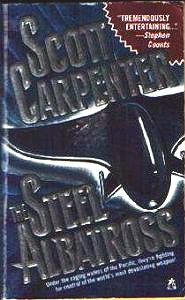
written two novels, both dubbed “underwater techno-thrillers.”
The first was entitled “The Steel Albatross.” The second, a
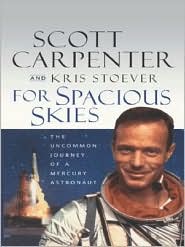
sequel, was called “Deep Flight.” His memoir, “For Spacious
Skies”, which he co-authored with his daughter Kristen Stoever,
published by Harcourt in January 2003.
Carpenter
is an honorary fellow in the Institute of Environmental
Sciences, a member of the Association of Space Explorers–USA,
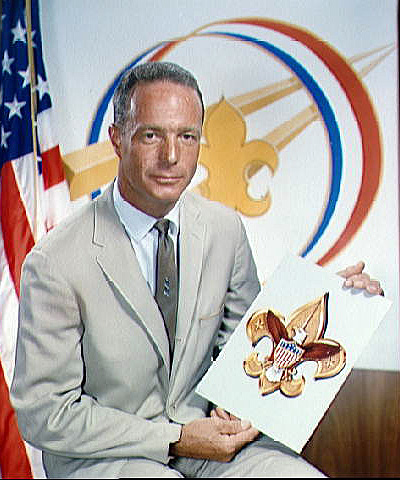
and a member of Delta Tau Delta. He has been awarded the Legion
of Merit, Distinguished Flying Cross, NASA Distinguished Service
Medal, Navy Astronaut Wings, University of Colorado Recognition
Medal, National Aeronautic Association's Collier Trophy, New
York City Gold Medal of Honor, Elisha Kent Kane Medal, Boy
Scouts of America Silver Buffalo, and Numismatica Italiana
Award.
Carpenter
is 5 feet 10 inches tall and weighs 160 pounds. He has brown
hair and green eyes. He was married to the former Rene Louise
Price of Clinton, Iowa, on September 9, 1948; they had four
children : Marc Scott, born November 29, 1949; Robyn Jay, born
March 4, 1962. 1949; Kristen Elaine, born June 26, 1955; Candace
Noxon, born October 8, 1956. they were later divorced. He
married the former Maria Roach, daughter of film producer Hal
Roach, in 1972, and married the former Barbara Curtin in 1988.
They have since divorced. He has two children from his second
marriage: Matthew Scott and Nicholas Andre, and one child from
his third marriage: Zachary Scott.
He lives
with his wife, the former Patty Barrett, in Vail, Colorado.
Between them they have nine children and six grandchildren.
Carpenter’s awards include
 The
Navy’s Legion of Merit The
Navy’s Legion of Merit
The Distinguished Flying Cross
The NASA
Distinguished Service Medal
U.S. Navy Astronaut Wings
The University
of Colorado Recognition Medal
The Collier Trophy
The New York City
Gold Medal of Honor
The Elisha Kent Kane Medal
The Ustica Gold
Trident
San
Diego Air and Space Museum Inductee
Founder
and Inductee - Astronaut Scholarship Foundation
The Boy Scouts of America Silver Buffalo
Maritime
Patrol Association’s Hall of Honor
He has been
awarded seven honorary degrees.
|